
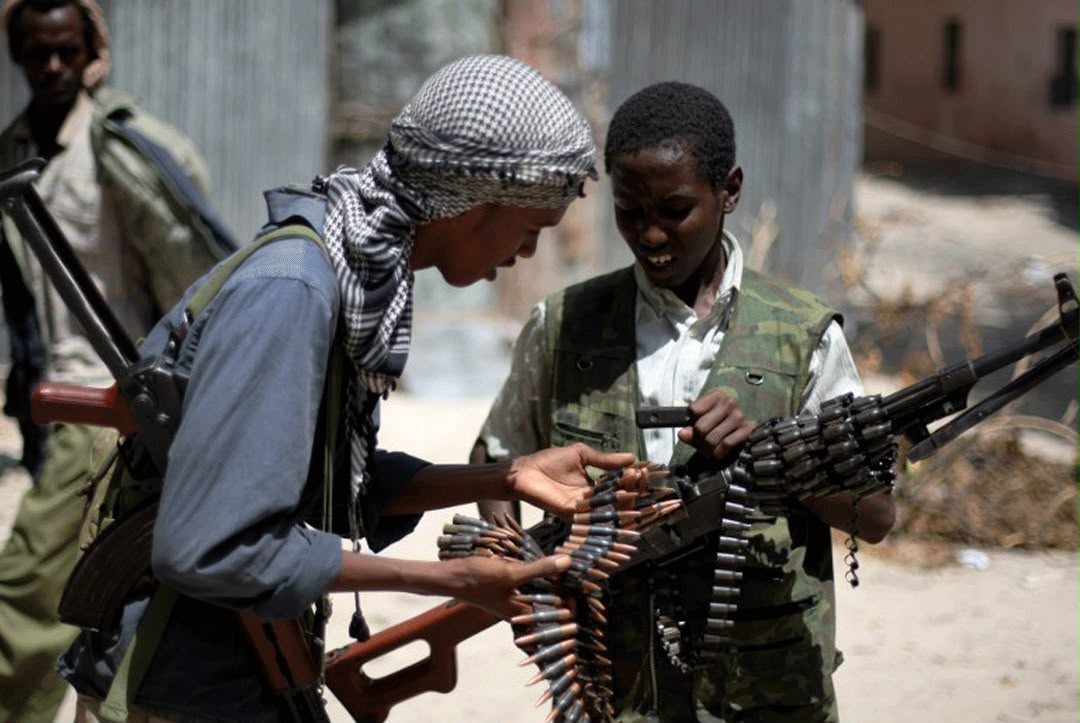
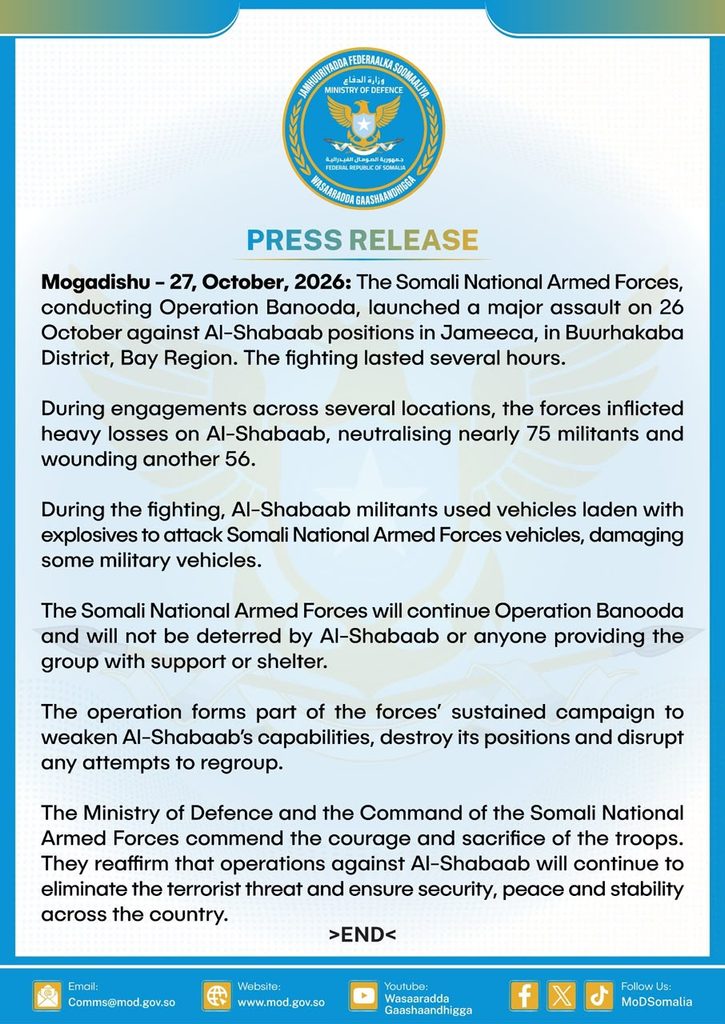
Somalia’s Ministry of Defence says government forces killed approximately 75 Al-Shabaab fighters and wounded another 56 during several hours of fighting in the Jameeca area of Buurhakaba district, in the country’s Bay region. But the government’s account has been accompanied by reports of heavy casualties among Somali troops, leaving the full cost of the battle unclear.
The Somali National Armed Forces launched the assault on October 26 as part of Operation Banooda, a military campaign targeting Al-Shabaab positions in southern Somalia. In a statement released on Tuesday, October 27, the Ministry of Defence said the fighting took place across several locations and formed part of continuing efforts to weaken the militant group, destroy its positions and prevent it from regrouping.
The ministry said Al-Shabaab fighters used vehicles loaded with explosives to attack Somali military vehicles during the engagement, damaging some of them. It did not disclose how many government soldiers had been killed or wounded, nor did it provide a detailed breakdown of the military equipment damaged.
A report by Reuters on Tuesday cited two Somali soldiers who said dozens of government troops had died in the battle. One soldier, identified as Ahmed, told the news agency that he had helped transport 40 dead soldiers and more than 100 wounded personnel to hospitals in Mogadishu. Another soldier, Farah, said vehicle-borne explosives had destroyed five military vehicles and estimated that dozens of troops had been killed in the blasts.
The accounts from the soldiers have not established a definitive casualty total, and the figures could not be independently verified. However, they raise serious questions about the scale of the government’s losses in an engagement that the Defence Ministry described primarily in terms of casualties inflicted on Al-Shabaab.
Al-Shabaab also claimed that its fighters had inflicted heavy losses on government forces. The group’s claims have not been independently confirmed. As with the government’s figures, the conflicting accounts should be treated cautiously while further information about the battle remains unavailable.
The discrepancy is significant because the Ministry of Defence’s statement gave precise figures for the number of militants killed and wounded while omitting losses among the government forces involved. Without independently verified figures from both sides, the overall military outcome cannot be fully assessed from the official statement alone.
The battle took place in a strategically important part of southern Somalia, where government forces have been conducting operations along routes linking the capital, Mogadishu, with Baidoa and other communities in the southwest. The wider Bay region has experienced prolonged insecurity, with Al-Shabaab maintaining a presence in rural areas and repeatedly clashing with Somali forces.
Operation Banooda began with reported fighting near Leego on October 24. The Ministry of Defence said government troops, including Danab special forces, killed seven Al-Shabaab fighters in that initial engagement and seized weapons. Those claims, too, could not be independently verified. The campaign has since moved into a broader confrontation around the route towards Buurhakaba.
Buurhakaba is important because of its position along the Mogadishu–Baidoa corridor, a route used for the movement of people, goods and security forces. Insecurity along the road has repeatedly complicated government operations and exposed military convoys to ambushes and explosive attacks. Fighting in the area therefore carries implications beyond the immediate positions targeted by either side.
The latest battle is unfolding amid wider political and security tensions in Somalia’s South West State. Regional forces aligned with former South West State president Abdiaziz Hassan Mohamed Laftagareen have been involved in a separate confrontation with federal-aligned forces over control of territory and political authority. Garowe Online reported that federal troops advanced toward Buurhakaba amid that dispute, although the precise relationship between the political confrontation and individual military decisions remains contested.
The overlapping pressures create a difficult environment for Somalia’s security forces. While the federal government continues to pursue Al-Shabaab, it must also contend with political divisions and armed confrontations involving forces opposed to the authorities in Mogadishu. Such divisions risk complicating military planning and diverting resources from the long-running campaign against the militant group.
Al-Shabaab has fought the Somali government for nearly two decades and continues to carry out attacks against security forces and civilians. The group seeks to overthrow the federal government and impose its own strict interpretation of Islamic law. Somali forces, supported at different times by international partners and African Union missions, have made territorial gains against the group, but maintaining control over contested areas has remained a persistent challenge.
Military operations are only one part of that challenge. Even where government forces remove fighters from a position, lasting security depends on whether authorities can maintain a presence, protect roads and settlements, and prevent militants from returning. Communities affected by repeated fighting also face risks of displacement and disruption to trade and access to essential services.
The Ministry of Defence said Operation Banooda would continue despite attacks by Al-Shabaab and warned that the campaign would also target those providing the group with support or shelter. The ministry and the army command praised the troops involved and said the wider objective was to reduce the group’s military capabilities and improve security across Somalia.
The government’s stated losses inflicted on Al-Shabaab would represent a significant blow if independently confirmed. But the reported deaths among Somali troops underline the cost of the fighting and the uncertainty surrounding the latest engagement. Until more reliable casualty figures and details of the battle become available, the government’s announcement should be understood as its account of the operation rather than a complete, independently verified assessment of the outcome.
For Somalia, the immediate question is not only how many fighters were killed in Jameeca, but whether Operation Banooda can achieve its stated objectives without further heavy losses and whether any gains can be held after the fighting ends. The latest battle demonstrates that the campaign in the Bay region remains dangerous, with both the government’s military objectives and the human cost still unfolding.
 Somalia



Comments0 ShowHide