
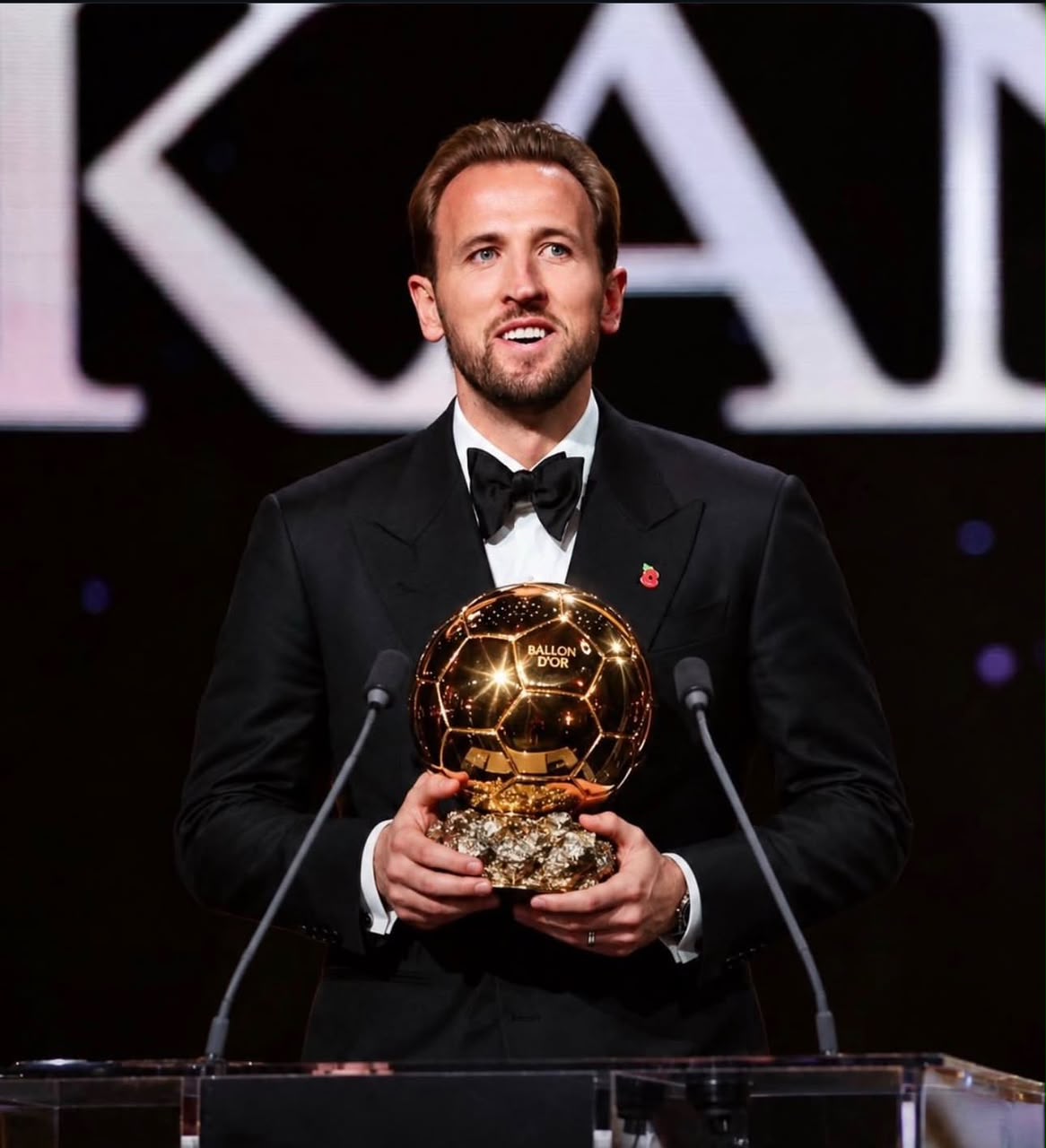
Harry Kane has won the 2026 Ballon d’Or after a remarkable season for Bayern Munich and England, finally receiving football’s most prestigious individual award after years of extraordinary goalscoring without a major senior team trophy. His victory carries a particularly powerful message: a player can spend much of his career collecting personal records without winning silverware, then find the missing piece at an age when many footballers are already approaching the end of their best years.
The England captain scored 61 goals in 51 appearances for Bayern across all competitions during the 2025/26 season, helping the German club win the Bundesliga and the DFB-Pokal. He also scored six goals for England at the 2026 World Cup as the national team reached the semi-finals. Those achievements helped him finish ahead of leading contenders including Kylian Mbappé and Barcelona teenager Lamine Yamal.
Kane’s triumph is the first time an Englishman has won the Ballon d’Or since Michael Owen in 2001. But the most compelling part of his story is not simply that he has become the latest name on the award’s distinguished list. It is how long he had to wait for the kind of team success that many footballers experience much earlier in their careers.
When Kane left Tottenham Hotspur for Bayern Munich in August 2023, he was already one of the most accomplished strikers in world football. He had become Tottenham’s all-time leading scorer with 280 goals in all competitions and had established himself as England’s record goalscorer, surpassing Wayne Rooney’s international tally in March 2023.
Yet his trophy cabinet did not reflect his individual achievements. Kane had finished as a Premier League top scorer three times, reached the Champions League final with Tottenham in 2019 and played in European Championship finals with England in 2021 and 2024. Each time, however, the ultimate team prize slipped away. Tottenham lost the Champions League final to Liverpool, while England were beaten by Italy and Spain in the European Championship finals.
For a striker whose career was defined by goals, records and consistent performances at the highest level, the absence of a major senior team trophy became an increasingly prominent part of his story. Kane was widely recognised as one of the best forwards of his generation, but he had not yet experienced the feeling of finishing a season as a major trophy winner.
His move to Bayern Munich was therefore about more than changing clubs or leagues. At 30, Kane left the Premier League, where he had spent almost his entire senior career, to join a club accustomed to winning domestic titles and competing deep into the Champions League. It was a major decision for a player who had already established himself as a legend at his former club but wanted the team honours that had eluded him.
The first season did not deliver the expected breakthrough. Bayern finished third in the Bundesliga in 2023/24, ending an extraordinary run of 11 consecutive league titles. Kane nevertheless scored 36 league goals, winning the Bundesliga scoring title and the European Golden Shoe. His individual numbers were exceptional, but the season ended with the same uncomfortable contrast that had followed him at Tottenham: personal success without a major team trophy.
The breakthrough finally arrived in 2025. Kane was 31 when Bayern secured the 2024/25 Bundesliga title, giving him the first major senior team trophy of his career after years of near misses and individual accolades. The moment mattered because it was not simply another medal added to a long list. It removed the one major criticism that had followed an otherwise outstanding career.
For many players, reaching their early thirties brings questions about declining speed, recovery and how many peak seasons remain. Kane instead entered a new phase of his career, continuing to score at an extraordinary rate and adding more honours. Bayern’s domestic success in 2025 gave him a foundation; the 2025/26 campaign elevated him further, with the Bundesliga and German Cup double followed by his first Ballon d’Or.
There is an important distinction between saying Kane had achieved nothing before Bayern and recognising what he had accomplished. He had already broken records for club and country, won individual scoring awards and represented England at major international tournaments. What he lacked was a major senior team trophy. His story shows how a player can be regarded as elite for years while still being judged against a team achievement that depends on far more than his own performance.
That distinction also makes Kane’s Ballon d’Or victory an interesting contrast with the careers of other football greats. Several players have won multiple league titles, domestic cups and Champions League trophies without ever receiving the Ballon d’Or. Andrés Iniesta, for example, won the World Cup, European Championships and numerous titles with Barcelona, yet never won the award. Xavi Hernández, another central figure in Barcelona and Spain’s trophy-laden era, also finished his career without claiming it.
Kane’s case demonstrates that team trophies and individual awards do not always arrive together. Winning a league title can depend on a squad’s consistency over an entire season, while the Ballon d’Or asks voters to decide which individual player has made the strongest overall case. Some players collect medals without winning the individual prize; others dominate individually for years before the right combination of performances, trophies and timing brings both within reach.
Kane’s 2026 season offered that combination. His 61 goals for Bayern across all competitions made him one of the most productive players in Europe, while the club’s domestic double gave those numbers greater weight. At the World Cup, he scored six times for England as the team reached the semi-finals. His contribution was not limited to club football, and his performances on the international stage strengthened his case in a year when the tournament carried enormous importance in the award debate.
Mbappé, meanwhile, experienced another Ballon d’Or disappointment despite a prolific campaign. The Real Madrid forward scored 58 goals for club and country during the season and finished as the leading scorer in La Liga and the Champions League. He also claimed the World Cup Golden Boot with 10 goals. Those numbers would have made him a serious contender in almost any year, but Kane’s combination of goals and team achievements ultimately proved decisive.
It would be wrong to describe Mbappé as a player who has never won anything. He was part of France’s 2018 World Cup-winning team, has won domestic league titles and cups, and has already established himself among the most successful forwards of his generation. The award that remains missing from his collection is the Ballon d’Or itself.
At 27, Mbappé still has time to win it. But the competition for future editions is becoming more demanding. Yamal is already a major figure at Barcelona, while Khvicha Kvaratskhelia, Arda Güler and other emerging talents are building careers that could bring them into the conversation. Individual awards are difficult to predict years in advance, but the field of potential contenders is unlikely to become less competitive.
Yamal left the ceremony with a historic achievement of his own, winning the Young Talent of the Year award for the third consecutive year. At just 19, the Barcelona winger has made the prize his own across three editions, having won it in 2024 and 2025 as well. His latest recognition followed another influential season in which he helped Barcelona win La Liga and the Spanish Super Cup.
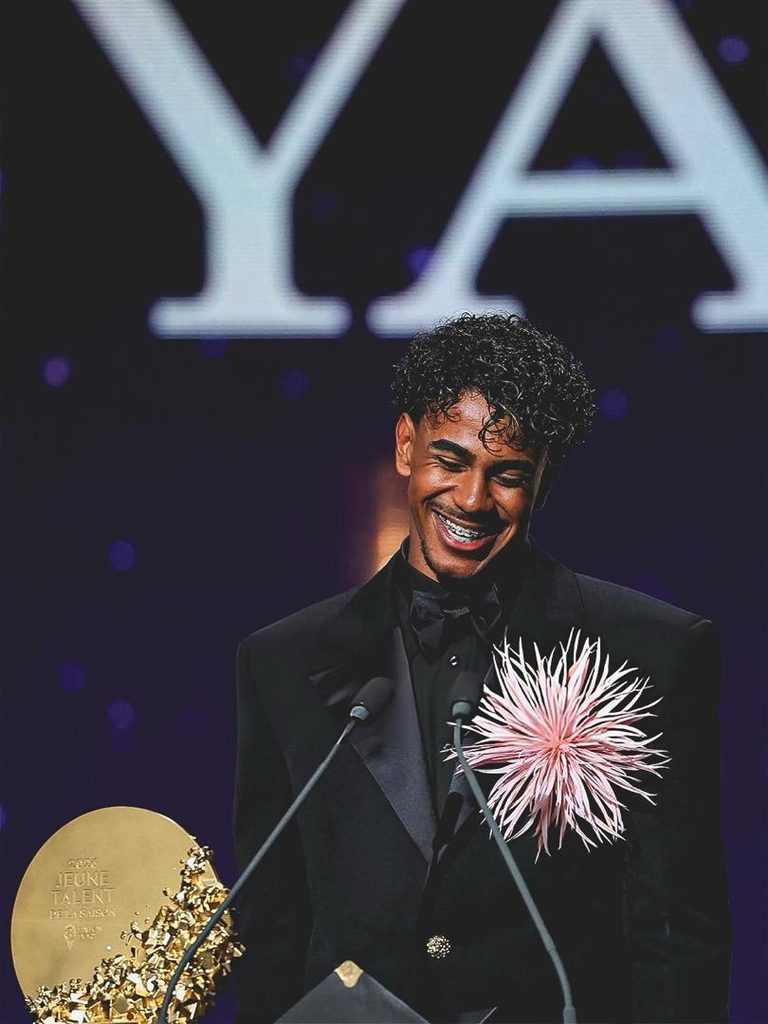
Yamal’s acceptance speech was notable for his decision to recognise a teammate rather than focus entirely on his own success. He said he believed Barcelona and Spain colleague Pau Cubarsí deserved the young-player award because of his performances for club and country. The comment drew attention to the contribution of a defender whose work can be less visible than the goals and assists that attract headlines.
Cubarsí played a significant role in Spain’s 2026 World Cup campaign and received FIFA’s Young Player Award at the tournament. His performances highlighted the importance of defensive organisation and composure in a team that reached the top of international football. Yamal’s praise was a reminder that the development of Barcelona and Spain’s next generation is not being driven by attacking talent alone.
The two teenagers represent different forms of influence. Yamal can change a game with dribbling, chance creation and finishing; Cubarsí can help determine a match by reading danger, organising the defence and building attacks from the back. Their recognition suggests that the next era of Spanish football may be shaped by a generation of players who are already contributing at the highest level.
Yamal’s third consecutive young-player award is particularly striking because he remains eligible for future editions. However, his next challenge will be to sustain his performances and turn his individual promise into continued success with Barcelona and Spain. The main Ballon d’Or is a different challenge, one that typically requires not only outstanding individual displays but also a season that stands above those of his rivals.
For Kane, the achievement is the culmination of a long journey rather than the beginning of one. He spent years being measured by his scoring records while the lack of a major trophy followed him from Tottenham into international football. At Bayern, the long-awaited breakthrough arrived at 31, and two seasons of domestic success have now been followed by the Ballon d’Or.
His career offers a useful reminder that football does not always reward players in a straight line. Some win major honours early, others spend years coming close, and a select few finally find the right combination of club, teammates and opportunity later in their careers. Kane’s story is not that age stopped mattering; it is that reaching 30 did not mean his most important achievements were behind him.
Mbappé’s continued wait for the Ballon d’Or, Yamal’s record third young-player award and Cubarsí’s World Cup recognition all tell different success stories. One is still pursuing a missing individual honour, another is building a record before reaching his twenties, and a third is earning recognition for work that can be overlooked when attention focuses on goals.
Kane now joins the Ballon d’Or winners after a season that delivered both individual excellence and major team honours. For a striker who once had almost every personal record he could want but no major senior trophy, the 2025 Bundesliga title changed the story. The 2026 Ballon d’Or has now taken it to another level.




Comments0 ShowHide