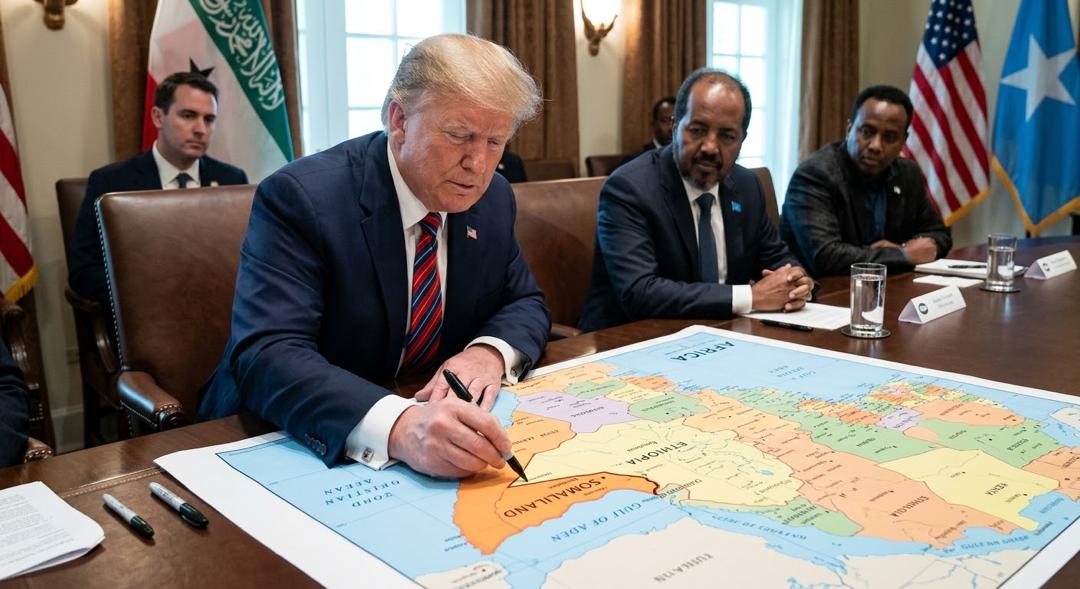
Somaliland has seized on US President Donald Trump’s remarks describing it as a country distinct from Somalia, viewing the comments as a possible opening in its decades-long campaign for international recognition. But while Hargeisa is using the moment to press for closer relations with the U.S., Somalia continues to insist that the territory remains part of its sovereign state.
The diplomatic debate has also been accompanied by confusion online after a document purporting to be a Somali foreign ministry statement condemning Trump’s comments circulated on social media. Somalia’s State Minister for Foreign Affairs, Ali Balcad, reportedly told Dawan Africa on October 13 that the document was not genuine. Its circulation does not, however, change Mogadishu’s established opposition to Somaliland’s independence.
The competing reactions highlight a dispute that goes beyond a single presidential comment. At its centre is a fundamental question in international relations: whether Somaliland should be treated as an independent state or as part of Somalia, whose government and most international institutions continue to defend the country’s territorial integrity.
Trump made the remarks at a rally in Youngstown, Ohio, on October 12, while discussing Somalia and Somali immigrants in the United States. Referring to Somaliland, he said: “I call it Somalia land, not Somaliland, because actually it’s a totally different country.” He also suggested that Somaliland should change its name.
The comments were not accompanied by an announcement of a new US recognition policy. Nevertheless, Somaliland’s government responded the following day with an official statement welcoming what it described as Trump’s acknowledgement of its sovereign status and expressing a desire to deepen engagement with his administration.
For Somaliland President Abdirahman Mohamed Abdullahi, known as Irro, the remarks offer an opportunity to renew a diplomatic argument that successive administrations in Hargeisa have pursued for more than three decades. Somaliland says it has maintained its own government, constitution, elections and security institutions since restoring its independence in 1991.
The territory’s claim is rooted in its history as the former British Somaliland protectorate, which became independent on June 26, 1960, before entering a union with the former Italian-administered territory that became Somalia. Somaliland says it restored its sovereignty within its earlier borders on May 18, 1991, following the collapse of Somalia’s central government and years of conflict.
Since then, Somaliland has developed its own political institutions and held multiple elections. Its leaders argue that its relative stability, functioning administration and historical boundaries distinguish its case from other separatist movements. Somalia, however, rejects the declaration of independence and maintains that Somaliland remains part of the Federal Republic of Somalia.
The disagreement reflects two competing principles in international affairs: the right of a people to determine its political future and the protection of existing states’ territorial integrity. Somaliland’s supporters emphasise its history, effective self-government and claim to restore an earlier independent status. Somalia argues that unilateral recognition threatens its national unity and could encourage further territorial fragmentation.
The diplomatic landscape shifted on December 26, 2025, when Israel formally recognised Somaliland as an independent and sovereign state, becoming the first United Nations member state to do so. The move was welcomed in Hargeisa but condemned by Somalia, which described it as a violation of Somalia’s sovereignty. The African Union and several other governments also reaffirmed their support for Somalia’s territorial integrity.
Israel’s decision gave Somaliland an important diplomatic breakthrough, but it did not trigger broad international recognition. Most countries have continued to avoid formally recognising the territory, even as some maintain practical engagement with its authorities.
Somaliland’s relationship with Taiwan provides another example of how disputed political status can shape international partnerships. The two established representative offices in 2020 and maintain close relations. Taiwan itself operates under a distinct and complicated diplomatic situation involving the People’s Republic of China, which claims Taiwan as part of its territory. The comparison illustrates how political recognition can remain contested even when an administration exercises substantial self-government, although the historical and legal circumstances of Somaliland and Taiwan are different.
Trump’s remarks have therefore attracted attention in Hargeisa not because they automatically establish US recognition, but because they may provide an opening for further political engagement. The United States has strategic interests in the Horn of Africa and the Gulf of Aden, a region close to major international shipping routes and affected by regional insecurity.
Somaliland has highlighted Berbera Port and the Berbera Corridor as potential assets for trade and investment, alongside cooperation on maritime security and counter-terrorism. Its government says a stronger relationship with Washington could deliver mutual benefits in regional security, commerce and infrastructure.
Irro has also sought to present Somaliland as a reliable partner for international cooperation. In its October 13 statement, the foreign ministry said the president had recently met US government officials in Washington and outlined a vision for closer relations based on shared interests, including security, trade and investment.
However, a public description of Somaliland as a distinct country is not the same as formal diplomatic recognition. Such recognition would require a clear decision by the US government. No formal US recognition announcement accompanied the remarks described in the reports, and Somaliland’s diplomatic status should not be presented as having changed on that basis alone.
The dispute over the document circulating in Somalia’s name adds another dimension to the story. The document claimed that Mogadishu had warned Washington against statements or policies that could encourage the division of Somalia. Balcad’s reported denial means it should not be treated as an authentic ministry statement. But the position it purported to express is consistent with Somalia’s publicly stated opposition to recognising Somaliland as independent.
For Somalia, the issue concerns more than diplomatic terminology. Recognition by additional countries could weaken Mogadishu’s claim to national unity and have consequences for regional diplomacy. For Somaliland, continued non-recognition limits its ability to participate fully in international institutions and establish conventional diplomatic relations with governments that still recognise Somalia’s territorial claim.
Somaliland will mostly likely to seek to turn the attention into progress towards recognition, while Somalia is likely to continue defending its internationally recognised borders and urging other governments not to legitimise secession.