
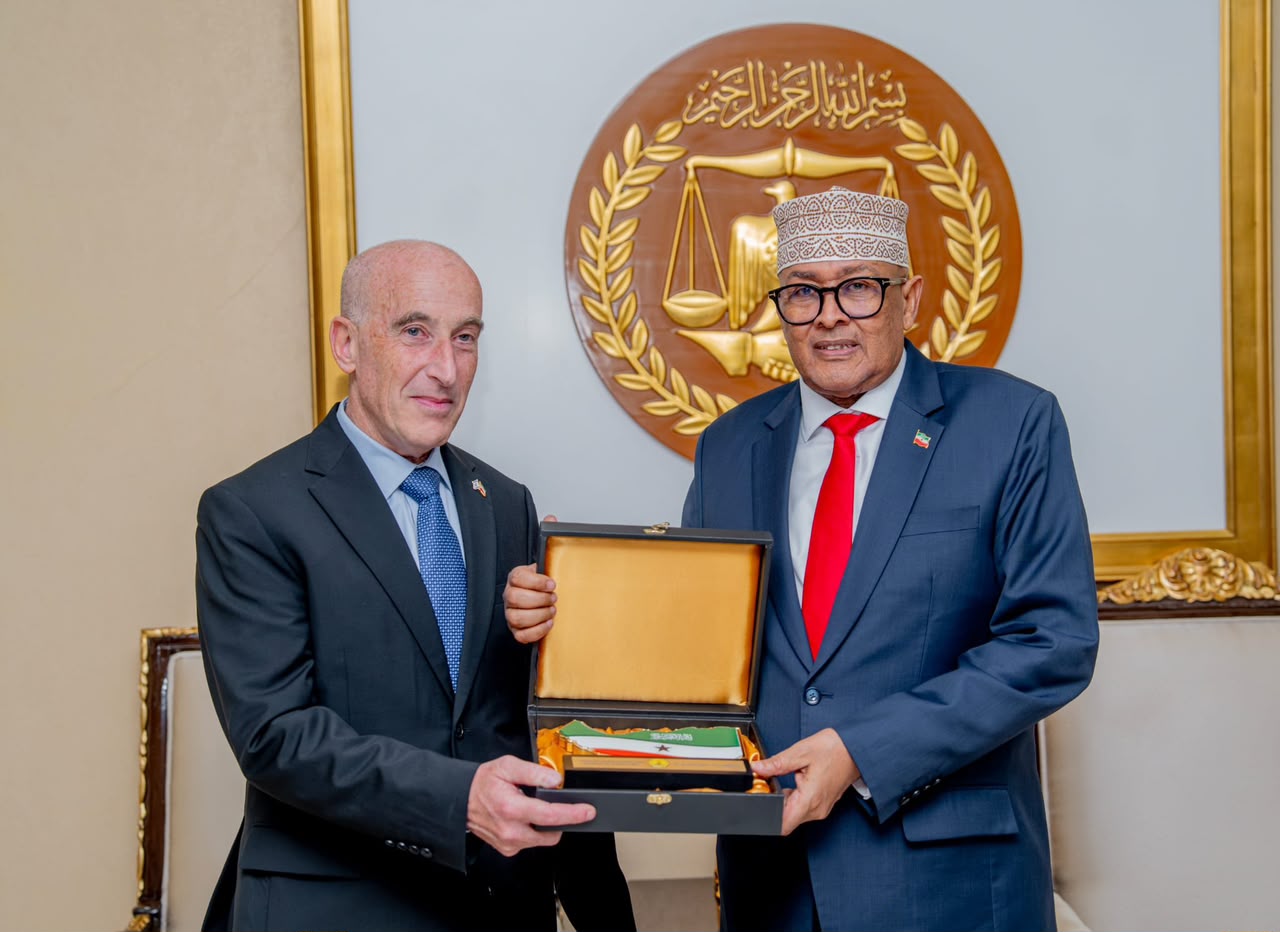
Israel has taken another step towards establishing a permanent diplomatic presence in Somaliland after its ambassador, Michael Lotem, presented his credentials to President Abdirahman Mohamed Abdullahi in Hargeisa, advancing a relationship that has become a major source of disagreement over Somalia’s territorial integrity.
The ceremony took place at the Presidential Palace in Hargeisa last week, according to Israel’s Foreign Ministry. It was followed by a cornerstone-laying ceremony for a new Israeli embassy in the city, signalling plans to establish a permanent diplomatic mission in the territory.
The appointment is the latest development since Israel formally recognised Somaliland as an independent state on 26 December 2025, becoming the first United Nations member state to take that step since Somaliland declared its independence from Somalia in 1991.
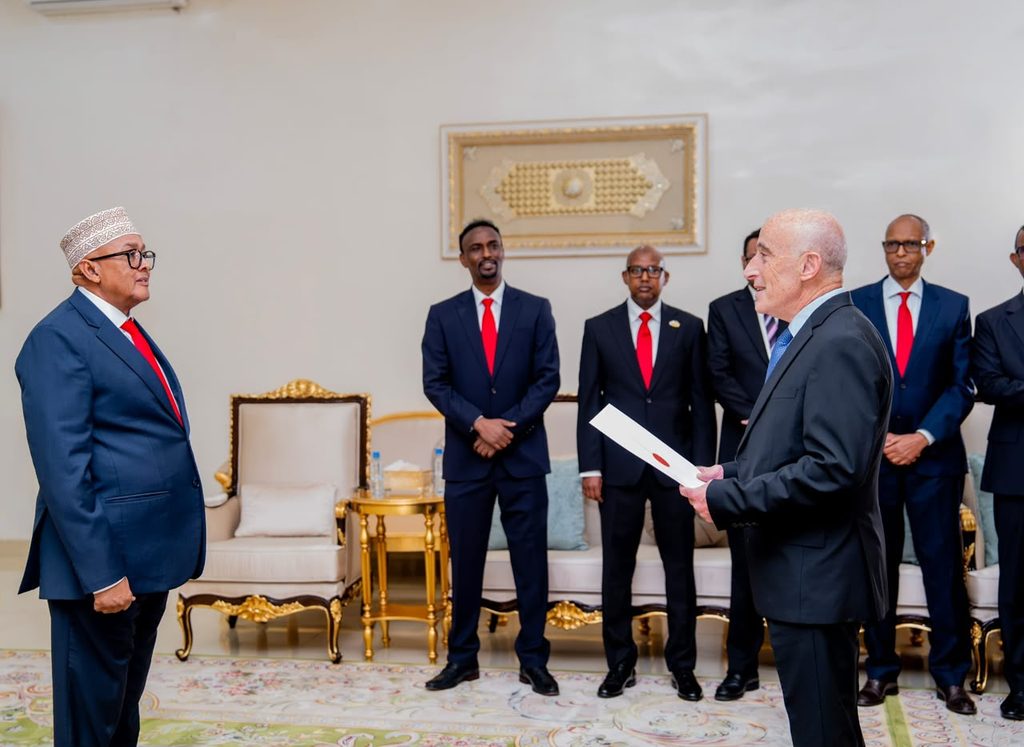
Israeli Foreign Minister Gideon Sa’ar described the exchange of ambassadors as another stage in strengthening relations between the two sides.
“Israel is determined to develop and strengthen its relations with Somaliland,” Sa’ar said in a statement accompanying the announcement.
He added that the appointment of ambassadors fulfilled an agreement reached when the two sides established mutual recognition, describing it as an important step in deepening their relationship.
For Somaliland’s leadership, the ceremony represents a further move towards the international recognition it has pursued for more than three decades. President Abdirahman Mohamed Abdullahi, widely known as Cirro, described the occasion as historic, saying it was the first time a Somaliland president had received the credentials of an ambassador representing a United Nations member state that recognises its independence.
Somaliland declared independence in May 1991 following the collapse of Somalia’s central government and the civil war. Since then, it has maintained its own administration, security institutions, currency and electoral system, while exercising control over much of the territory it claims.
However, its status remains disputed. Somalia considers Somaliland an integral part of the Federal Republic of Somalia and rejects attempts by foreign governments to recognise it as an independent country. Until Israel’s announcement in December 2025, no United Nations member state had formally recognised Somaliland’s independence since its 1991 declaration; only recent remarks by Donald Trump could imply that the United States could soon recognize Somaliland as an independent country.
The disagreement is rooted in competing understandings of the territory’s history. Somaliland’s authorities argue that they restored the independence of the former British Somaliland Protectorate, which became independent on 26 June 1960 before entering into a union with the former Italian-administered territory that formed the Somali Republic. Somalia’s federal government maintains that the union created one sovereign country whose territorial integrity must be preserved.
The African Union has consistently supported Somalia’s unity and territorial integrity. Following Israel’s recognition announcement, the AU Commission rejected the move, arguing that Somaliland remains part of the Federal Republic of Somalia and warning against actions that could undermine established borders and regional stability.
The European Union also reaffirmed its support for Somalia’s sovereignty and territorial integrity, while encouraging dialogue between Hargeisa and Mogadishu to resolve their longstanding differences.
The United Nations has similarly highlighted the regional implications. In a briefing to the Security Council in January 2026, UN Assistant Secretary-General Khaled Khiari outlined Somalia’s rejection of Israel’s decision and recalled the Council’s repeated support for Somalia’s sovereignty, territorial integrity, political independence and unity.
The latest diplomatic development has therefore taken place against an international backdrop in which Israel and Somaliland are deepening their relationship while Somalia and several regional and international organisations continue to reject the recognition on which that relationship is based.
The relationship has developed quickly since December. Israeli Foreign Minister Gideon Sa’ar visited Somaliland in January 2026, while President Cirro travelled to Israel in June. During that visit, Somaliland opened an embassy in Jerusalem, establishing its own diplomatic presence in Israel.
The appointment of Michael Lotem now advances the reciprocal side of that arrangement. Lotem has previously served as Israel’s ambassador to Kenya, Azerbaijan and Kazakhstan. His presentation of credentials in Hargeisa, together with the planned embassy, gives the relationship a more permanent diplomatic structure.
The strategic location of Somaliland is also an important part of the wider discussion. The territory lies along the Gulf of Aden, close to the Bab el-Mandeb Strait, one of the world’s most important maritime passages connecting the Indian Ocean with the Red Sea and the Suez Canal.
That geography has attracted growing international attention, particularly as insecurity around the Red Sea and the wider Horn of Africa has affected commercial shipping and regional security.
Somalia’s President Hassan Sheikh Mohamud has questioned Israel’s intentions, arguing in an interview with Sky News that Israel’s interest is driven by access to the Red Sea rather than simply support for Somaliland’s independence. He also alleged that Israel was interested in establishing a naval base in the territory.
Somaliland officials have indicated openness to hosting an Israeli military base, although President Cirro has said that no discussions on such an arrangement have taken place. The distinction matters: an expressed willingness to consider a proposal is not evidence that a military-base agreement has been reached.
For Israel, closer relations with Somaliland could provide a diplomatic and strategic foothold in a region bordering major international shipping routes. For Somaliland, the relationship offers an opportunity to expand its international partnerships, attract investment and strengthen its campaign for wider recognition.
However, the consequences extend beyond the two governments. Any arrangement involving military facilities, maritime security or regional operations could affect neighbouring countries and add another dimension to the competition for influence in the Horn of Africa.
The announcement has also generated disagreement among Somali social media users. In a comment accompanying discussion of the Israeli diplomatic move, Alhaaji Jama Yusuf rejected the idea that Somaliland should be treated as a separate state, arguing that northern Somalia is part of Somalia and describing the independence claim as a grievance associated with the Isaaq community.
His comment reflects one strand of opposition to Somaliland’s statehood claim, although it should not be mistaken for a complete account of the region’s political history or the range of views among its communities. Somaliland’s independence movement has its own historical, political and institutional arguments, while supporters of Somali unity maintain that the territory’s separation would undermine the country’s territorial integrity.
The debate is therefore not simply about whether Israel can establish diplomatic relations with the authorities in Hargeisa. It also concerns the wider question of how Somaliland’s status should be resolved, the role of international recognition and the consequences of bilateral agreements for Somalia and the region.
The presentation of credentials by Michael Lotem marks a concrete step in Israel’s relationship with Somaliland. The planned embassy in Hargeisa will further institutionalise those ties, but neither development resolves the dispute between Somaliland and Somalia or establishes broad international acceptance of Somaliland’s independence.
Comments0 ShowHide