
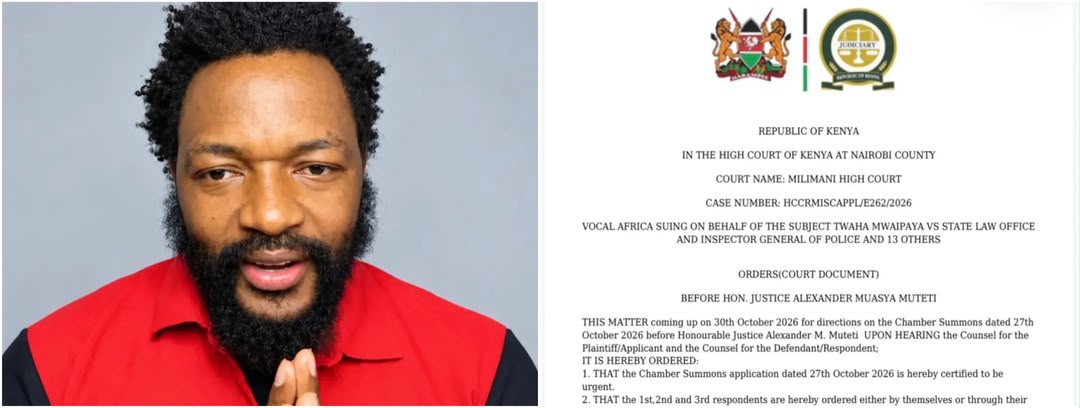
Kenya’s High Court has ordered senior police officials to produce missing Tanzanian opposition activist Twaha Mwaipaya before the court, either alive or dead, as it seeks answers over his disappearance and the circumstances surrounding his reported arrest.
The order was issued on Friday, October 30, by Justice Alexander Muasya Muteti at the Milimani High Court in Nairobi, following an urgent application filed by human rights organisation Vocal Africa on Mwaipaya’s behalf.
The court directed the Inspector General of Police, the Director of Criminal Investigations (DCI) and the Officer Commanding Ruai Police Station to produce Mwaipaya before it on Monday, November 2, at 11:00 a.m. They must also present the original warrant authorising his detention and explain why he should not be immediately released from custody.
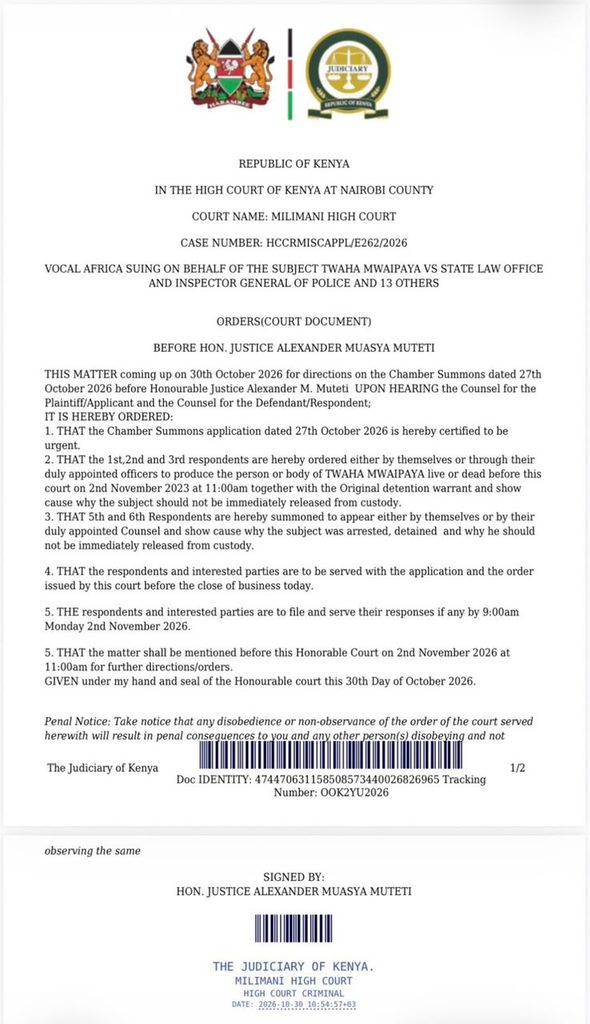
In its order, the court directed the three respondents, either personally or through officers duly appointed by them, to produce “the person or body of Twaha Mwaipaya live or dead” before the court.
Justice Muteti also summoned the fifth and sixth respondents, requiring them to appear either personally or through their advocates and explain the circumstances surrounding Mwaipaya’s arrest and detention, including why he should not be released immediately.
The application, dated October 27, was certified as urgent. The court further directed the respondents and interested parties to be served with the application and the orders before the close of business on Friday. They were required to file and serve any responses by 9:00 a.m. on Monday, ahead of the scheduled court mention at 11:00 a.m.
The case follows the reported disappearance of Mwaipaya on Sunday, October 25, in the Kamulu area on the outskirts of Nairobi. According to information presented by Vocal Africa in its court application, the Tanzanian activist was travelling in a taxi when armed men allegedly intercepted the vehicle and took him away.
The organisation’s account states that the incident happened at Kanisani stage in Kamulu, where the men were allegedly travelling in a black double-cabin pickup. A friend who was reportedly accompanying Mwaipaya is said to have escaped and later provided an account of what happened.
Vocal Africa’s chief executive, Hussein Khalid, said efforts to establish Mwaipaya’s whereabouts had not yielded answers. The organisation told the court that a missing-person report had been filed at Ruai Police Station under Occurrence Book number 47/25/10/2026, but that subsequent attempts to trace him through police stations had been unsuccessful.
According to the application, neither Mwaipaya’s family nor his lawyers had been informed of the reasons for his alleged arrest, the agency responsible for holding him or the place where he was being detained.
The organisation therefore sought the court’s intervention through a habeas corpus application, a legal procedure that allows a person’s detention to be brought before a court for examination. It is intended to prevent unlawful detention by requiring the authorities to account for a person’s whereabouts and the legal basis for holding them.
Vocal Africa and other human rights advocates have expressed concern that Mwaipaya could face torture, detention without communication or other human rights violations. The organization also raised the possibility that he could be forcibly transferred to Tanzania, where it alleges he may face further risks because of his political activities and criticism of the government. These concerns form part of the applicants’ case and have not been established as findings by the court.
Mwaipaya is a Tanzanian opposition activist associated with CHADEMA and has been described in reports as a youth organizer and mobilization figure. His disappearance in Kenya has drawn attention to the safety of political activists operating across national borders, particularly where allegations of abduction and undisclosed detention are involved.
The case has also attracted attention because it places the responsibility on Kenyan security authorities to clarify whether Mwaipaya is in their custody and, if so, to produce the legal documentation authorising his detention. If he is not being held by the named authorities, the court’s order places them under pressure to account for what they know about his whereabouts.
The High Court has not, through the order, determined who took Mwaipaya or established that the police were responsible for his disappearance. Instead, it has directed the relevant officials to appear, produce him and provide an explanation, allowing the court to examine the circumstances of the case.
The matter is scheduled to return to the Milimani High Court on Monday, November 2, at 11:00 a.m., when the court is expected to consider the responses and issue further directions.





Comments0 ShowHide