
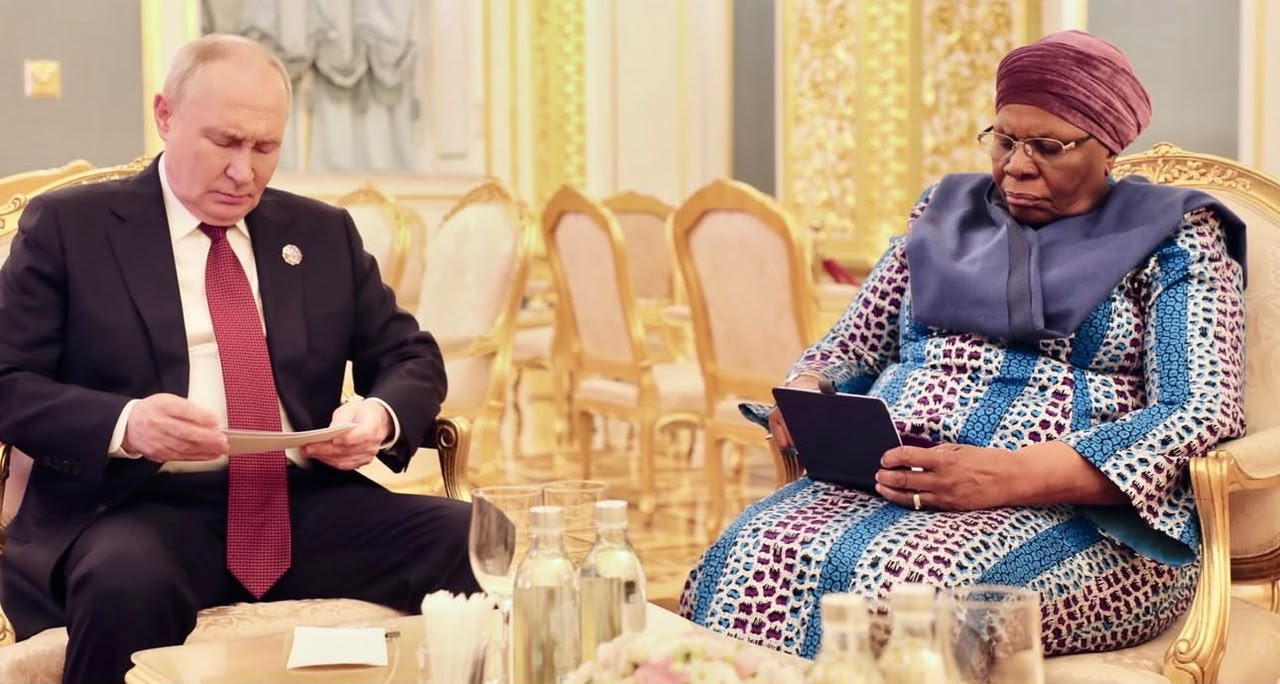
Namibian President Netumbo Nandi-Ndaitwah has held bilateral talks with Russian President Vladimir Putin in Moscow, using the sidelines of the Third Russia-Africa Summit to discuss ways of strengthening relations between the two countries and expanding areas of cooperation.
The Namibian Presidency announced the meeting on October 29, saying the discussions focused on strengthening the cordial relationship between Namibia and the Russian Federation and exploring new areas of cooperation for the mutual benefit of their people.
The announcement did not disclose specific agreements reached or provide details of any commitments made during the talks. However, the meeting comes as Namibia seeks to translate its longstanding diplomatic relationship with Russia into greater trade, investment and industrial development.
Before travelling to Moscow, Nandi-Ndaitwah said Namibia intended to use the summit to pursue partnerships that could support job creation, industrialisation, technology transfer and economic diversification. The country is particularly interested in expanding cooperation in mining, energy, agriculture, education, science and technology.
Her visit also comes at a time when Namibia is seeking to gain more value from its natural resources instead of relying primarily on the export of unprocessed minerals. Mineral beneficiation, which involves processing raw materials before they are exported, is among the priorities identified by the Namibian government as it looks to expand domestic industries and create employment.
The meeting with Putin therefore provides an opportunity for Windhoek to explore how Russian investment, technical expertise and industrial partnerships could support those ambitions. Russia has experience in sectors including mining, energy, nuclear technology and heavy industry, although the extent to which that expertise can translate into projects in Namibia will depend on the terms of future cooperation.
Nandi-Ndaitwah also addressed the wider Russia-Africa partnership during the summit, calling on both sides to move beyond declarations of intent and focus on practical outcomes that improve people’s livelihoods.
Speaking at the gathering on October 29, she said cooperation should produce tangible results through trade, technology transfer, skills development and stronger economic links. Her message reflected Namibia’s stated position that international partnerships should be assessed by the opportunities they create for its citizens and their contribution to national development.
The Third Russia-Africa Summit, held in Moscow on October 28 and 29 under the theme “For Peace, Security and Development,” brought together representatives from 48 African countries, including more than 20 heads of state, according to reports from the gathering. Discussions covered trade, investment, energy, agriculture, food security, security cooperation, technology and infrastructure.
For Russia, the summit is part of a broader effort to strengthen its political and economic relationships across Africa. Moscow has sought to expand cooperation with African governments in areas ranging from agricultural supplies and energy to military partnerships, education and infrastructure, while presenting itself as an alternative partner to Western countries.
Putin has repeatedly emphasised the importance of closer relations with African states, pointing to the Soviet Union’s historical support for liberation movements across the continent. During the summit, he called for stronger economic cooperation and greater African representation in international institutions.
Namibia’s relationship with Russia is rooted partly in that shared history. The Soviet Union supported the South West Africa People’s Organisation (SWAPO) during Namibia’s struggle for independence from South African rule, providing political, diplomatic and military assistance to the liberation movement.
Namibia became independent on March 21, 1990, and established diplomatic relations with Russia on the same day. Since then, the two countries have maintained cooperation across several sectors, including mining, energy, agriculture, education, healthcare, science and technology.
That history continues to shape their diplomatic relationship, but Namibia’s current priorities are increasingly economic. The government wants international partnerships to contribute to industrialisation, employment and a more diversified economy.
The Namibia-Russia Intergovernmental Commission on Trade and Economic Cooperation remains one of the main mechanisms for advancing those objectives. Its 11th session was held in Windhoek in March 2026, where officials explored opportunities to expand trade, investment and development cooperation.
The latest meeting between Nandi-Ndaitwah and Putin provides another high-level opportunity to advance that work. However, the Presidency’s announcement has so far offered no indication of specific investment projects, financial commitments or agreements emerging from the bilateral talks.
That distinction matters as African governments increasingly face pressure to demonstrate that international summits produce more than diplomatic statements and ceremonial meetings. For Namibia, the measure of progress will be whether discussions with Russia lead to investment that supports local industries, creates jobs, develops skills and allows more of the country’s mineral wealth to be processed domestically.
The summit has also highlighted the wider competition among global powers for stronger relationships with African countries. Russia, China, the United States and European governments have all sought deeper economic and political engagement with the continent, offering different forms of trade, investment, security and development cooperation.
Comments0 ShowHide