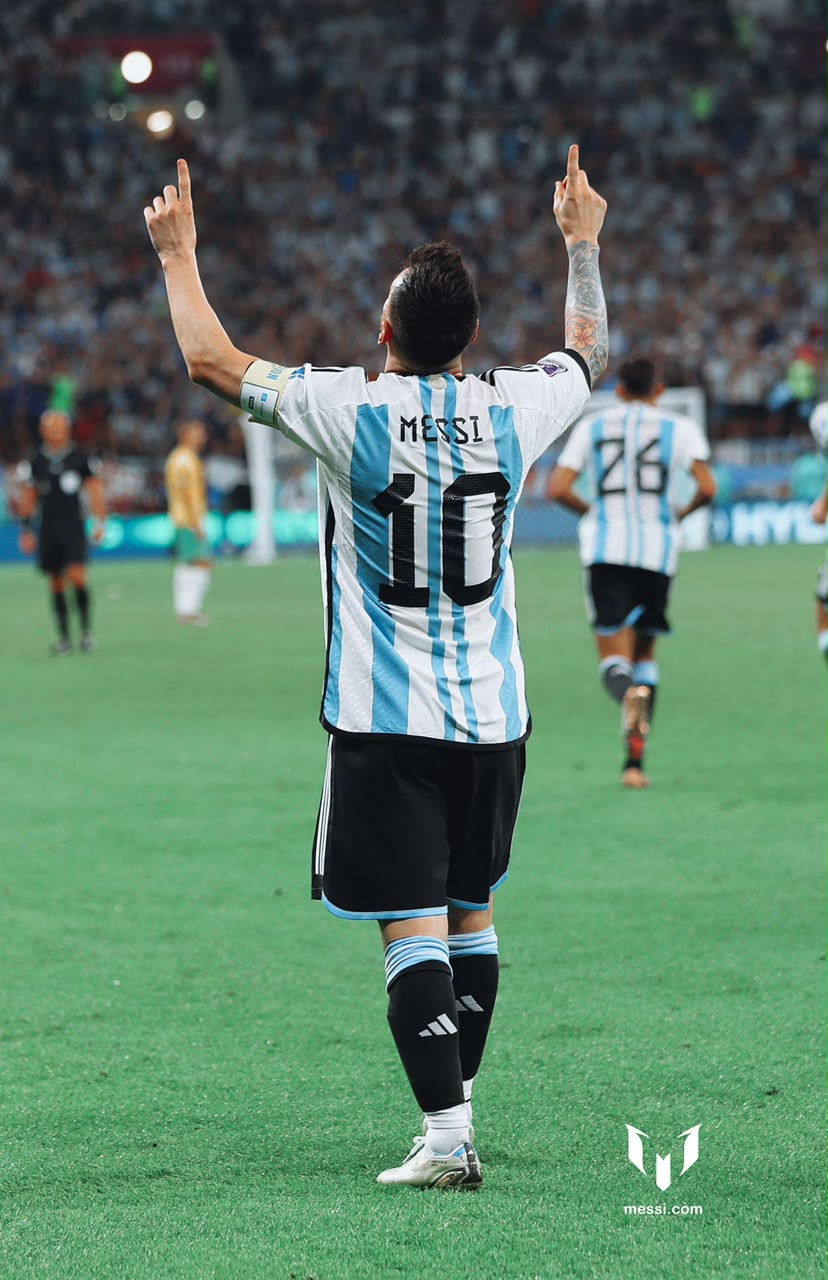
Lionel Messi has brought his Argentina career to an end in the most fitting way possible: with a victory, a goal, two assists and another Man of the Match performance.
The 39-year-old captain played his final international match on Tuesday as Argentina defeated Benin 3-0 at a packed Monumental Stadium in Buenos Aires, closing a 21-year relationship with the national team that began in 2005 and eventually developed into one of the most successful international careers in the history of the game.
Messi created Argentina’s opening goal for Nicolás Otamendi before setting up Nico Paz for the second. He then scored from the penalty spot in the 71st minute to complete the victory and take his international tally to 126 goals.
He leaves Argentina as the country’s most-capped player and its leading scorer, having made 208 appearances. His final figures also include 69 assists, numbers that underline the extent of his influence beyond simply finishing attacks.
But Messi’s international career cannot be judged solely through statistics. His importance to Argentina is also defined by the change in his relationship with the country.
From persistent criticism to national icon
Messi’s early years with Argentina were considerably more complicated than the ending suggests.
Although he had already established himself as one of the world’s best players at Barcelona, his performances for the national team were repeatedly measured against the enormous expectations attached to Diego Maradona’s legacy.
Argentina reached the 2007 Copa América final, the 2014 World Cup final and the 2015 and 2016 Copa América finals during Messi’s international prime, but failed to win any of them.
The 2014 World Cup was particularly significant. Messi was awarded the Golden Ball after Argentina reached the final in Brazil, but Germany’s extra-time victory denied him the major international title that many believed his career required.
Two years later, following another Copa América final defeat to Chile, Messi temporarily retired from international football.
It was a remarkable point in a career that had already produced almost everything at club level.
The decision did not last.
Messi returned, continued as Argentina captain and eventually became the central figure in one of the most successful periods in the country’s modern football history.
The turning point came in 2021
Argentina’s victory over Brazil in the 2021 Copa América final at the Maracanã finally gave Messi his first senior major international trophy.
That victory changed the conversation around him.
The criticism that had followed him for years began to disappear, while the relationship between Messi and Argentine supporters became increasingly positive.
The following year, Argentina defeated Italy in the Finalissima before Messi led the team through the 2022 World Cup in Qatar.
That tournament completed the part of his career that had remained unresolved.
Messi scored seven goals, provided three assists and won the Golden Ball as Argentina defeated France on penalties in one of the most memorable World Cup finals ever played.
For Argentina, it was the country’s first World Cup title since 1986.
For Messi, it removed the last major argument against his place among the greatest players in football history.
He was no longer being asked whether he could deliver for Argentina.
He had delivered.
Two Copa América titles and a World Cup
Messi’s international success did not end in Qatar.
Argentina retained the Copa América title in 2024, defeating Colombia in the final in Miami.
That gave Messi a second Copa América championship alongside the 2021 title and the 2022 Finalissima.
His international trophy cabinet therefore ended with four senior titles: the 2021 Copa América, 2022 Finalissima, 2022 World Cup and 2024 Copa América.
Including his youth and Olympic achievements, his Argentina honours extend even further, with the 2005 FIFA Under-20 World Cup and the 2008 Olympic gold medal also part of his international record.
He was still producing at 39
What makes Messi’s decision to retire internationally particularly interesting is that his numbers do not suggest a player who had simply reached the end of his usefulness.
Only a few months before his farewell, Messi had helped Argentina reach another World Cup final in the United States.
Argentina ultimately lost 1-0 to Spain, with Messi leaving the field in tears, but his tournament remained statistically outstanding.
He finished the 2026 World Cup with 12 goal contributions, including eight goals and four assists, second only to Kylian Mbappé in the tournament’s overall attacking production.
That performance came at 39.
It is therefore reasonable to argue that Messi could still have contributed to Argentina’s next generation. His retirement is less a consequence of an obvious physical or statistical decline than a decision about where he believes his international career should end.
That distinction matters.
Footballers rarely get the opportunity to leave while they can still perform at the highest level.
Messi has chosen to do exactly that.
His final performance reflected the player he became
There was also significance in the manner of his final appearance.
More than 85,000 supporters filled the Monumental, while Messi became visibly emotional before the match as Argentina prepared to celebrate his international career.
The match itself was briefly paused in the 10th minute for an ovation in recognition of his famous No. 10 shirt.
But once the game resumed, the occasion did not turn Messi into a ceremonial player.
He remained Argentina’s creative reference point.
He produced the assist for Otamendi, created the second for Paz and converted the penalty that completed the 3-0 victory.
It was not simply a farewell appearance. Messi was still determining the outcome of the match.
That perhaps explains why his decision feels premature to some observers.
Argentina will now have to move on
Messi’s departure leaves Argentina without the player who has been at the centre of its attack for more than 15 years and without the captain who led the country through its most successful period in decades.
Yet Argentina is not leaving the Messi era without options.
Players such as Nico Paz and others from the country’s emerging generation will now have greater responsibility, and Tuesday’s match itself offered a symbolic glimpse of that transition when Paz scored the second goal after receiving Messi’s assist.
The challenge for Argentina will not simply be replacing Messi’s goals.
It will be replacing his ability to create chances, dictate the rhythm of important matches, attract defenders and provide a technical solution when games become difficult.
Those qualities cannot be reproduced by simply giving another player the No. 10 shirt.
Messi leaves with little left to prove
There is a strong argument that Messi could have continued internationally.
His age alone does not explain his decision. His performances do not either.
But international retirement is ultimately a personal decision, and Messi has already achieved the principal objective that once seemed to elude him.
He won the World Cup.
He won the Copa América twice.
He won the Finalissima.
He became Argentina’s record appearance holder and leading scorer.
He played in three World Cup finals and finished his international career with 208 appearances, 126 goals and 69 assists.
Most importantly, he changed the way Argentina viewed him.
For years, Messi was the superstar who was expected to reproduce his club form for his country. By the end, he had become the captain of a team that had won virtually everything available to it.
His decision may therefore be early by statistical standards, but it is difficult to argue that he is leaving with unfinished business.
Messi has chosen the point at which he wants his Argentina story to end.
And after more than two decades, four senior international trophies and a record that places him at the top of virtually every major Argentina statistical category, the country’s greatest modern footballer can now step away knowing that the question of what he achieved for the national team has long since been answered.