
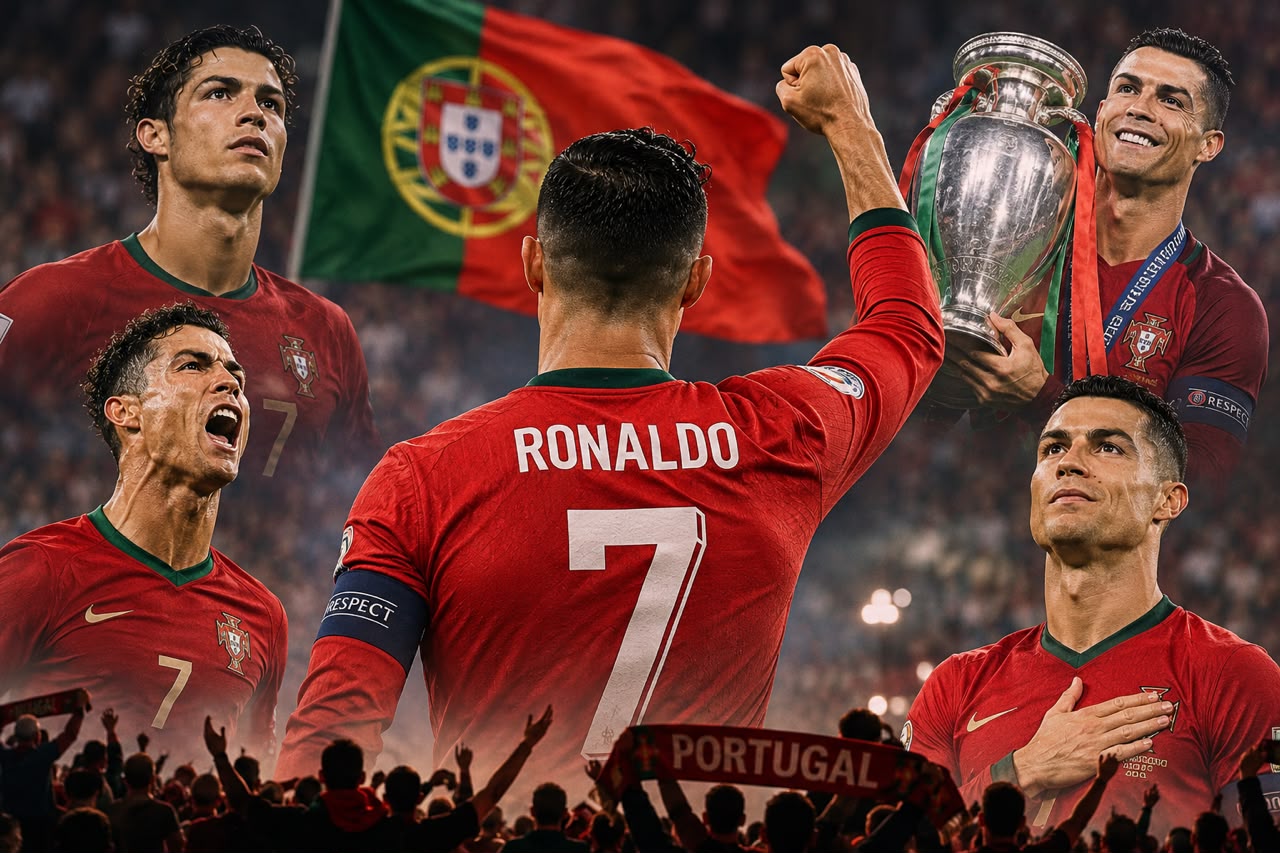
There are footballers you admire, footballers you enjoy watching, and footballers whose careers become part of your own life. For me, Cristiano Ronaldo has always belonged to the last category. I have supported him since 2008, which means that for more than 18 years, I have carried an attachment to a player, a shirt and a national team that has never really belonged to my country. I am not Portuguese. I do not even speak Portuguese. Yet, whenever Portugal played, I found myself hoping, celebrating, worrying and sometimes suffering as though the result had a personal connection to me. And now, after all these years, the man who made that possible has announced that he is handing back the number seven shirt.
On November 5, 2026, Cristiano Ronaldo announced his retirement from international football, bringing an end to a journey with Portugal that began in August 2003. At 41, after 234 appearances and 146 goals, he leaves the national team as the most prolific men’s international goalscorer and the most capped men’s international player in football history. He will continue his club career with Al Nassr, but the sight of him walking onto a football pitch wearing Portugal’s number seven will no longer be something we can take for granted.
It is difficult to explain what this announcement means to someone who has followed him for so long. Football has a way of making us grow alongside the people we watch. We remember where we were when certain goals were scored, the shirts we wore, the arguments we had with friends, the celebrations that seemed to last forever and the disappointments that took days to overcome. For some of us, Ronaldo was never simply a player appearing on a television screen. He was a constant presence through different stages of life. We watched him grow, watched him break records, watched him carry expectations and watched him return, again and again, determined to prove that there was still something left to give.
When I began supporting him in 2008, I was watching a young Portuguese star who had already announced himself to the world. I could not have imagined that the journey would last this long. I did not know that I would spend nearly two decades cheering for Portugal, learning its players, recognizing its opponents and feeling the tension of its biggest matches. I did not need to understand every word spoken in Portuguese to understand what happened whenever Ronaldo scored. I did not need a Portuguese passport to feel a little happiness when Portugal won. A footballer had somehow made a foreign national team feel familiar to me.
That is one of the extraordinary things about Ronaldo’s international career. He not only represented Portugal to the Portuguese. He made people from distant countries develop an emotional relationship with a national team they might otherwise have rarely followed. In Africa, Asia, the Americas and across Europe, millions of people found themselves wearing his shirt, defending his name, celebrating his goals and hoping that Portugal would go further because their favorite player was wearing its colors. Some supported him because of his football. Others because of his discipline, ambition, confidence or refusal to accept that his best days had passed. Many, like me, simply stayed.
But the number seven was never only about the people watching from elsewhere. For Portugal, Ronaldo became the face of a generation. He inherited the responsibility of representing a country with a proud football history and helped take it to achievements that had once remained beyond its reach. Portugal had never won a major senior men’s international tournament before the 2016 European Championship. In France, Ronaldo captained the team through a campaign that ended with Portugal lifting the trophy for the first time. He was forced off injured in the final against France, but he remained involved from the sidelines, encouraging his teammates as they completed the job. It was a victory that belonged to the entire team, but his leadership and years of service were inseparable from the story.
The years that followed brought another European achievement: Portugal won the inaugural UEFA Nations League in 2019 and lifted the trophy again in 2025. Ronaldo was part of both successes, adding to a national-team career that stretched across generations of Portuguese footballers. He played in six World Cups, scored at all six, and kept returning to the biggest stage long after many players of his generation had left international football. His records are remarkable, but numbers alone cannot explain what he meant to Portugal.
Some goals seemed impossible, headers that defied gravity, free kicks that sent stadiums into celebration and moments when his determination appeared stronger than the circumstances around him. There were also missed chances, painful defeats, tears and tournaments that ended earlier than anyone had hoped. His career was not a perfect sequence of victories. That is precisely why it meant so much. He experienced the full weight of representing a country: the expectations, the criticism, the responsibility and the knowledge that millions of people were waiting for him to deliver.
In his farewell message, Ronaldo said something that deserves to remain long after the records are broken. He explained that when he looked back, he did not see only matches, goals, records or trophies. He saw people. He remembered Portuguese immigrants who felt their country a little closer during those 90 minutes, and millions of supporters he had never personally met but who had become part of his life. He described the moment the national anthem began, the players around him and the families in the stands. For those few minutes, he said, differences disappeared. There were no clubs, colors, social classes, professions or opinions. There was only one passion: Portugal.
Perhaps that is the most beautiful part of his farewell. He understood that the shirt was never simply fabric with a number printed on the back. It was a meeting point for people who might never otherwise meet. It carried the hopes of children, the pride of parents, the memories of grandparents and the longing of people living thousands of miles from home. It gave supporters a reason to gather, sing, cry and celebrate together. And somehow, it reached people who were not Portuguese at all.
That includes me.
For more than 18 years, I have been one of those people waiting to see what number seven would do next. I have supported him through the great nights and the difficult ones, without taking breaks or needing a reason to renew my loyalty. I have watched Portugal because of him, and somewhere along the way, I developed an affection for the country itself. I never needed to understand every conversation around the national team. The football was enough. The shirt was enough. Ronaldo was enough.
It is strange to think that the next generation will have to learn what it means to watch Portugal without expecting Cristiano Ronaldo to lead the line. Another player will eventually wear the number seven. Another captain will stand in front of the team. Another generation will sing the anthem, chase trophies and create memories. That is how football survives. No player owns a national team forever, and Ronaldo himself has acknowledged that the shirt belongs to the future.
But whoever wears it next will inherit something that cannot be measured by the number on the back. They will inherit the memory of a player who turned the shirt into a worldwide symbol, who carried Portugal through 23 years of international football and who gave supporters reasons to believe even when the odds were against them. They will inherit a standard set by a man who spent his career trying to push the limits of what was possible.
There will be arguments about whether Cristiano Ronaldo is the greatest footballer of all time. There always have been, and there always will be. Football has room for different generations, different styles and different definitions of greatness. But no debate can take away what he has achieved, the influence he has had or the number of people whose lives he touched through the game. For me, he is my greatest. That is not a demand that everybody must agree. It is a personal truth built over 18 years of watching, believing and celebrating.
Today, I am not ready to say goodbye to the number seven. Perhaps I never will be. I know he is not disappearing from football, and I will continue watching him wherever he plays. But something has changed. A chapter that began when a young man from Madeira first wore Portugal’s colors is closing, and those of us who grew up following that journey must learn to watch the national team without him.
To Cristiano Ronaldo: thank you for the goals, the records, the celebrations, the memories and the years you gave to Portugal. Thank you for making a boy from Madeira feel like he could take on the world, and for making a supporter thousands of miles away feel connected to a country he had never called home. Thank you for giving us a reason to keep believing, even when the final whistle did not bring the result we wanted.
You said the number seven was never exclusively yours. Perhaps that is why it became so special. You wore it for Portugal, but millions of us found a little piece of ourselves in it.
The shirt will remain. Another player will wear it. Portugal will keep playing. And the world will keep watching.
But there will only ever be one Cristiano Ronaldo.
For 18 years, I cheered for the Portuguese number seven. I would do it all over again.
Obrigado, Cristiano. Portugal estará sempre em ti. And number seven will always mean something to us.

Comments0 ShowHide