
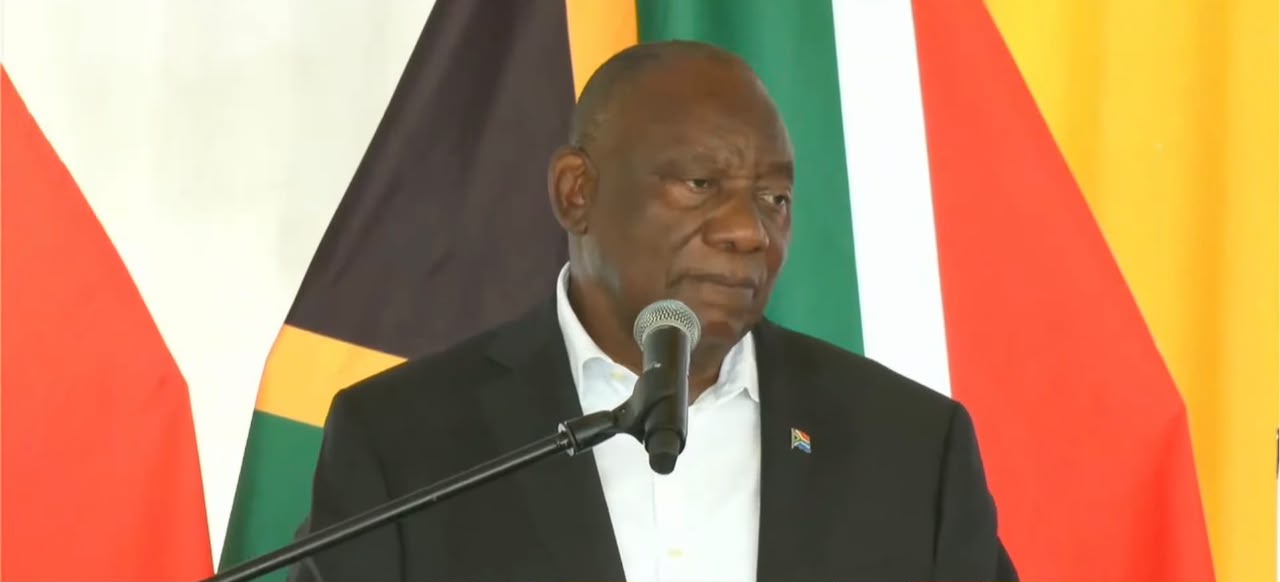
South African President Cyril Ramaphosa has called for a broader approach to housing delivery, saying government developments should do more than provide families with roofs over their heads by creating jobs, supporting local businesses and bringing communities closer to essential services and economic opportunities.
Speaking on Thursday, October 29, during the Cornubia Integrated Human Settlement milestone celebration in eThekwini, KwaZulu-Natal, Ramaphosa said the development reflected a shift in how South Africa plans and delivers housing. He described human settlements as catalysts for economic activity, arguing that communities should benefit from construction, maintenance, retail and other opportunities created around housing projects.
“Cornubia is part of a broader shift in the way we provide housing as a nation,” he said. “We recognise human settlements as catalysts for economic development, creating opportunities for local businesses, job creation and community growth.”
The President said the government intended to ensure that the development continued to support local participation and expand economic opportunities, so that residents could benefit from the project beyond receiving permanent homes.
His remarks came as the government marked progress at Cornubia, a large-scale development designed to combine housing with schools, health facilities, shops, recreational spaces and transport infrastructure. The project is also part of efforts to address the spatial inequalities inherited from apartheid-era urban planning, which left many black communities living far from employment centres and essential services.
Ramaphosa said South Africa needed to move away from an approach that concentrated on building houses without adequately considering where people would live in relation to work, education, healthcare and public transport.
He argued that integrated human settlements should bring these facilities together, reducing the time and money residents spend travelling while allowing people from different income groups to live in the same neighbourhoods.
The Cornubia development covers more than 1,300 hectares and is expected to accommodate more than 110,000 people over the next 10 to 15 years. Its plans include schools, clinics, early childhood development centres, libraries, sports facilities, community halls, places of worship and police stations.
The first phase has delivered more than 2,600 houses, while further phases are under construction. The wider project is expected to provide 12,593 housing units through different programmes, including fully subsidised homes, social housing and financing support for households in the so-called missing middle.
One immediate priority is providing permanent accommodation for families displaced by the devastating floods that struck KwaZulu-Natal in 2022. Many affected households initially moved into emergency shelters and temporary accommodation after losing their homes.
During Thursday’s event, houses were handed over to families affected by the floods. Ramaphosa said another 145 homes were under construction in Phase 2 and that the government expected a total of 460 permanent homes to have been completed by mid-2027.
He acknowledged that the relocation process had taken years and that families who remained in temporary accommodation continued to face difficult living conditions. Some had struggled with cramped accommodation, limited access to public transport and long journeys to school for children.
“Emergency accommodation must never become a permanent way of life,” he said, stressing that the ultimate objective must be permanent housing that restores dignity and provides families with a stable foundation.
The President also recognised that the government could not celebrate completed houses without addressing the people who were still waiting. He said delays in construction, beneficiary lists and the issuing of title deeds needed to be resolved, with clear timelines communicated to affected communities.
“Where families have received permanent homes, we celebrate that progress. But for the families still waiting, the wait carries a real cost in lost opportunity,” Ramaphosa said.
He called for greater transparency in the allocation of houses, saying residents should receive clear information about eligibility, construction progress and relocation dates rather than depending on rumours. He also warned against fraud, queue-jumping, unlawful occupation and interference with beneficiary lists.
Beyond the provision of housing, the economic potential of Cornubia is becoming increasingly important to the project. The Cornubia Business Park, which is being developed alongside the residential areas, has already created approximately 300 jobs during construction. The wider development is expected to generate more than 2,000 jobs.
Ramaphosa said investment in eThekwini could create further opportunities for residents, but argued that people needed affordable housing close to employment centres to benefit from that growth. High transport costs, he noted, place additional pressure on households already dealing with the rising cost of living.
The government is also seeking to change its wider housing model. Ramaphosa said it was expanding affordable housing, working to revitalise commuter rail, releasing well-located public land and introducing subsidy arrangements to help people build, buy or rent homes in suitable areas.
He said the government wanted to move beyond simply constructing houses for beneficiaries towards supporting people to secure housing through different options, while also unblocking stalled projects.
The scale of the national challenge remains considerable. According to figures cited by Ramaphosa, more than five million housing opportunities have been delivered since the beginning of democratic government in 1994. The proportion of households living in formal dwellings increased from 65 per cent in 1996 to more than 88 per cent in 2022.
However, rapid urbanisation and population growth have continued to increase demand. Nearly four million people remain on the national housing needs register, according to the President, highlighting the gap between the progress already made and the number of people still seeking adequate housing.
Cornubia is intended to demonstrate how housing and urban development can be planned together rather than treating homes as isolated projects. Its schools, retail facilities, clinic, sports infrastructure and planned business activities are meant to support a functioning community as the population grows.
But maintaining the development will be as important as completing it. Ramaphosa said the government would not allow the project to fall into disrepair, calling for cooperation between national and provincial authorities, the eThekwini Municipality, implementing agencies, community leaders and residents.
He also warned against corruption, extortion and patronage in the delivery of the project, insisting that opportunities created through construction and local participation must be handled transparently.
The Cornubia milestone therefore comes with two parallel responsibilities for the government: completing the homes and infrastructure promised to residents, while ensuring that the development becomes an economically active and properly maintained community.
For families displaced by the 2022 floods, the immediate priority remains receiving permanent homes after years of uncertainty. For the wider population expected to live in Cornubia, the longer-term question is whether the development will deliver the jobs, transport links, public services and local businesses needed to support everyday life.
Ramaphosa said the government needed to finish what it had started and ensure that no family was left waiting. His message was that the success of Cornubia should ultimately be measured not only by the number of houses built, but also by the opportunities and quality of life created for the people who live there.






Comments0 ShowHide