


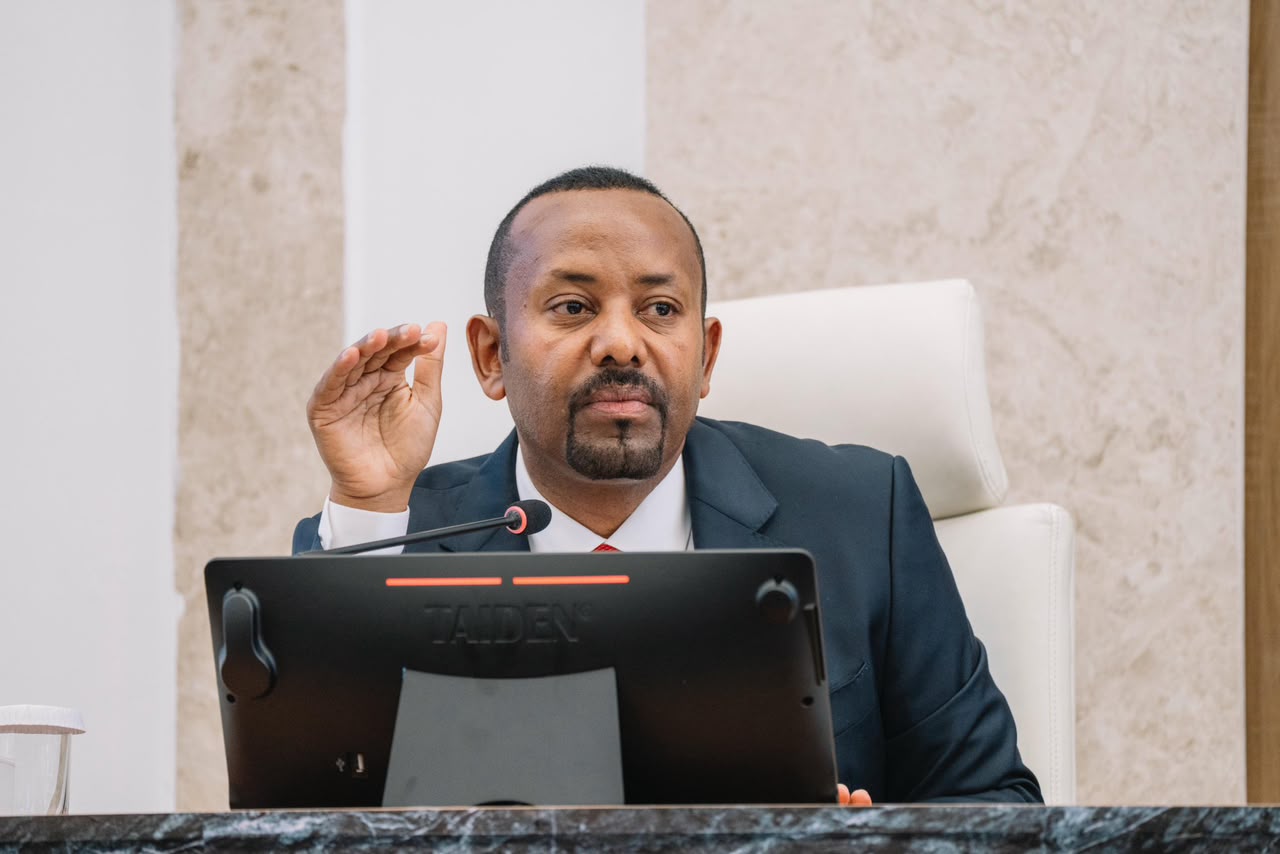
Ethiopian Prime Minister Abiy Ahmed has warned Eritrea that it could face destruction if its government continues supporting forces hostile to Ethiopia, while urging the neighbouring country to abandon its differences with Addis Ababa and pursue joint economic development.
In a statement published on X on Thursday, November 26, 2026, Abiy accused the Eritrean government of supplying weapons to Ethiopia’s adversaries and serving as a channel for military support to groups seeking to destabilize his administration. He presented two demands to Asmara: end its alleged support for Ethiopia’s enemies and cooperate with Ethiopia on economic development.
“Now, there are two things we want from the Eritrean government: first, stop arming Ethiopia’s enemies, acting as a supply line for weapons, and collaborating with Ethiopia’s adversaries. Second, let us work together for mutual development,” Abiy said.
He maintained that Ethiopia was prepared to contribute financial resources, expertise and labour to joint development projects, saying the only requirement was cooperation from the Eritrean side.
Abiy also revisited what he described as Ethiopia’s unsuccessful attempts to establish closer economic relations with Eritrea following the restoration of diplomatic relations between the two countries in 2018.
He said his government had helped bring Eritrea out of international isolation by facilitating diplomatic engagement with neighbouring countries and flying Eritrean representatives on Ethiopian aircraft to establish connections with regional governments.
Among the proposals he cited was an offer to supply Eritrea with electricity at the same domestic rates charged to Ethiopian consumers, arguing that the arrangement could help address electricity shortages in the neighbouring country. However, he claimed Eritrea rejected the proposal, alongside other offers to jointly construct roads and develop port infrastructure.
The Ethiopian leader accused Eritrea’s ruling establishment of lacking an interest in economic development, arguing that its refusal to pursue regional infrastructure and energy partnerships had prevented both countries from benefiting from closer cooperation.
Relations between the two countries have deteriorated considerably since their military cooperation during Ethiopia’s 2020–2022 war in the northern Tigray region.
Abiy acknowledged Eritrea’s assistance to Ethiopian federal forces following the November 2020 attack on the Northern Command, describing the initial cooperation as an example of good neighbourliness. However, he accused Eritrean forces of later entering Tigray and killing young people, destroying infrastructure and looting property.
The Ethiopian prime minister also linked the deterioration in relations to the November 2022 Pretoria Agreement, which ended the two-year conflict between Ethiopia’s federal government and the Tigray People’s Liberation Front (TPLF). Eritrea, despite fighting alongside Ethiopian forces, was not included in the negotiations or named as a signatory to the agreement.
Abiy said the Eritrean government became resentful following the agreement, further complicating efforts to restore cooperation between the neighbours.
His latest remarks come amid a serious diplomatic breakdown, with Ethiopia and Eritrea severing diplomatic relations in October after Addis Ababa ordered the closure of its embassy in Asmara and expelled 10 Eritrean diplomats. Eritrea subsequently announced that it was cutting diplomatic ties with Ethiopia.
The two governments have also exchanged accusations over military involvement in Ethiopia’s internal conflicts. Addis Ababa has repeatedly accused Asmara of supporting armed groups fighting the federal government, allegations that Eritrea has denied.
In September, seven Ethiopian armed groups, including the TPLF and the Amhara Fano National Movement, announced an alliance seeking to overthrow Abiy’s government. Ethiopian officials subsequently accused Eritrea of providing financial and military support to the coalition.
Eritrea has, in turn, accused Ethiopia of pursuing territorial ambitions against its sovereignty, particularly over access to the Red Sea. The issue has become a major source of tension since Abiy renewed his government’s commitment to securing maritime access for landlocked Ethiopia, with the Eritrean port of Assab frequently featuring in discussions about the country’s strategic interests.
Despite the sharp accusations, Abiy maintained that peaceful coexistence remained possible if Eritrea abandoned what he described as its hostile policies and agreed to cooperate on regional development.
He warned, however, that continued support for Ethiopia’s adversaries would have serious consequences for Eritrea, saying the destruction would ultimately fall on the neighbouring country if its ruling establishment persisted in what he called an incorrigible mistake.
The latest statement adds to growing concerns over relations between the two Horn of Africa neighbours, whose renewed confrontation could have consequences extending beyond their shared border.








Comments0 ShowHide