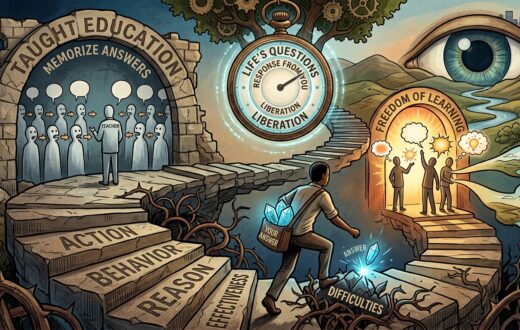
True wisdom is not a surface display of intelligence, but a deep understanding that begins with genuine self-awareness. It is easy to confuse the accumulation of scattered information with real understanding. In a world where people are often judged by how quickly they answer questions, how confidently they speak, or how much they appear to know, the temptation to perform intelligence can become greater than the desire to develop it. Yet the ability to impress others is not the same as the ability to think clearly, make sound judgments, or understand the world beyond its surface.
A person may know the names of countless theories, quote respected thinkers, and participate in conversations about subjects they have barely studied. Such knowledge can create an impression of intelligence, but impressions are easily constructed. Genuine understanding requires something more demanding: the willingness to question what one believes, examine the reasons behind those beliefs, and recognize when an apparently convincing answer does not withstand closer examination. The difference between depth and display lies not in how much a person can say, but in how carefully they have learned to think.
Self-awareness is the foundation of this process. Without it, knowledge can become a tool for protecting the ego rather than discovering the truth. People naturally prefer information that confirms their existing opinions and often resist ideas that challenge their sense of identity. When this happens, learning becomes selective. We listen to agree rather than understand, argue to win rather than discover, and defend our positions even when the evidence suggests that we should reconsider them. A person who cannot examine their own thinking will struggle to distinguish intellectual growth from the mere accumulation of arguments.
Developing self-awareness requires turning inward, something that becomes difficult when the mind is constantly overwhelmed by noise, external opinions, and competing demands for attention. Silence creates the space necessary to observe our thoughts without immediately reacting to them. It allows us to examine our motivations, recognize our fears, and question the assumptions that quietly shape our decisions. In moments of reflection, we may discover that some of our strongest opinions were formed through habit, social pressure, or the desire to belong rather than through careful consideration.
Silence, however, should not be confused with wisdom in itself. A person can spend hours alone and still avoid confronting uncomfortable truths. Reflection becomes valuable when it leads to honest examination and changes the way we understand ourselves and others. The purpose is not simply to escape the noise of the world, but to develop the clarity needed to return to it with greater patience, discernment, and intention.
The pursuit of knowledge also demands a distinction between knowing something and understanding it. Information can be collected quickly, repeated confidently, and forgotten just as easily. Understanding takes longer because it requires us to connect ideas, examine their implications, and consider where they apply and where they fail. Knowing a definition is not the same as understanding a principle. Being able to repeat an argument is not the same as recognizing its weaknesses. Real learning begins when information becomes something we can question, explain, apply, and use to make better judgments.
This distinction matters in a culture that often rewards speed and visibility. People are encouraged to have opinions about everything, respond immediately to every controversy, and remain informed about an endless stream of subjects. The pressure to participate can make admitting ignorance feel like a personal failure. As a result, some people speak before they have thought carefully, offer conclusions before examining the evidence, and confuse constant commentary with meaningful contribution.
Yet there is no shame in not knowing. Every serious pursuit begins with limitations, unanswered questions, and mistakes. The willingness to acknowledge those limitations is not a sign of weakness; it is a necessary condition for learning. When a person admits that they do not understand something, they create an opportunity to investigate it honestly. When they pretend to know, they may protect their image for a moment, but they sacrifice the possibility of genuine improvement.
Intellectual humility does not mean doubting everything or refusing to take a position. It means holding beliefs in proportion to the evidence available and remaining willing to revise them when better reasons emerge. Confidence becomes more valuable when it is supported by understanding, just as certainty becomes more dangerous when it is maintained without examination. The goal is not to appear unsure about everything, but to know the difference between what has been established, what remains uncertain, and what one has yet to learn.
Depth also requires discipline in choosing where to direct attention. There is value in exploring different subjects, encountering unfamiliar perspectives, and developing a broad understanding of the world. However, breadth becomes a limitation when the desire to know a little about everything prevents the effort required to understand anything well. Constantly moving from one interest to another can create the feeling of progress without the substance of achievement. The mind remains busy, but its understanding never develops beyond the introductory stage.
Mastery asks for a different kind of commitment. It requires patience with repetition, attention to small details, and the willingness to remain with a difficult problem long after the initial excitement has disappeared. Whether someone is developing a craft, studying a discipline, building a business, or refining an artistic skill, meaningful progress often comes from returning to the same fundamentals until they are understood at a deeper level. What appears simple to an observer may represent years of practice, correction, and careful thought.
This is why depth cannot be rushed. The desire for immediate recognition often conflicts with the slow work of becoming competent. Recognition may arrive before mastery, and public attention may reward what is easily noticed rather than what has been carefully developed. But external approval cannot substitute for the internal standards that sustain meaningful work. A person who measures progress only by applause may eventually become more concerned with maintaining an image than improving the ability that created it.
The same principle applies to relationships and everyday judgment. Understanding another person requires more than hearing their words or forming an opinion from a single encounter. It demands attention to context, patience with complexity, and a willingness to recognize that people may be carrying experiences we cannot immediately see. Superficial judgment offers quick conclusions, while deeper understanding accepts that human motives and circumstances are not always simple. The more carefully we listen, the less likely we are to mistake our first impression for the whole truth.
Depth also changes the way we offer guidance. Helping others solve problems can be meaningful, but the desire to be useful must be balanced with personal boundaries and an honest recognition of our own limitations. Not every problem belongs to us, and not every question requires an immediate answer. Trying to fix everything can scatter our attention and leave little energy for the responsibilities that genuinely depend on us. Sometimes the wiser response is to listen, ask a better question, or acknowledge that a situation requires knowledge and experience we do not possess.
There is an important difference between being helpful and needing to be seen as indispensable. The first comes from a sincere concern for others; the second can arise from a desire for approval or control. When our sense of worth depends on having an answer for every difficulty, we may begin to overestimate our abilities and underestimate the value of other people’s judgment. Wisdom allows us to contribute where we can, step back where necessary, and understand that responsibility does not require pretending to possess unlimited knowledge.
Ultimately, depth over display is a choice about what we value. We can spend our lives trying to look informed, capable, and impressive, or we can devote ourselves to becoming more thoughtful, competent, and honest. The first approach depends heavily on the opinions of others. The second depends on the quality of our effort, the integrity of our reasoning, and our willingness to keep learning even when nobody is watching.
True growth is often quiet. It happens when we reconsider an old belief, admit a mistake without searching for excuses, practice a difficult skill when recognition is unlikely, or choose not to speak simply because silence is more appropriate. These moments may never attract attention, but they shape the substance of a person’s character. Over time, the difference becomes visible not merely in what that person knows, but in how they act, how they listen, and how they respond when certainty is no longer possible.
Exceptional mastery demands deliberate depth, but depth should not become an excuse for narrow-mindedness. The aim is not to reject curiosity or dismiss knowledge outside our chosen pursuits. It is to build a strong foundation in what matters while remaining open to ideas that broaden our understanding. A thoughtful person can explore widely without pretending to be an expert in every field, and can pursue mastery without assuming that mastery makes them incapable of error.
The deepest form of intelligence may therefore be found in the balance between confidence and humility, knowledge and curiosity, ambition and patience. It is the ability to recognize how much can be learned without feeling compelled to demonstrate everything one knows. It is the discipline to pursue understanding when superficial recognition would be easier, and the courage to let truth matter more than personal pride.
In the end, the measure of wisdom is not how convincingly we can perform intelligence, but how honestly we can examine ourselves and how responsibly we use what we learn. Display may attract attention, but depth builds understanding. One can be admired for what one appears to know, yet become genuinely valuable through what one has taken the time to understand. The difference is found in the quiet work beneath the surface, where knowledge becomes judgment, reflection becomes character, and learning becomes a lifelong practice rather than a performance.