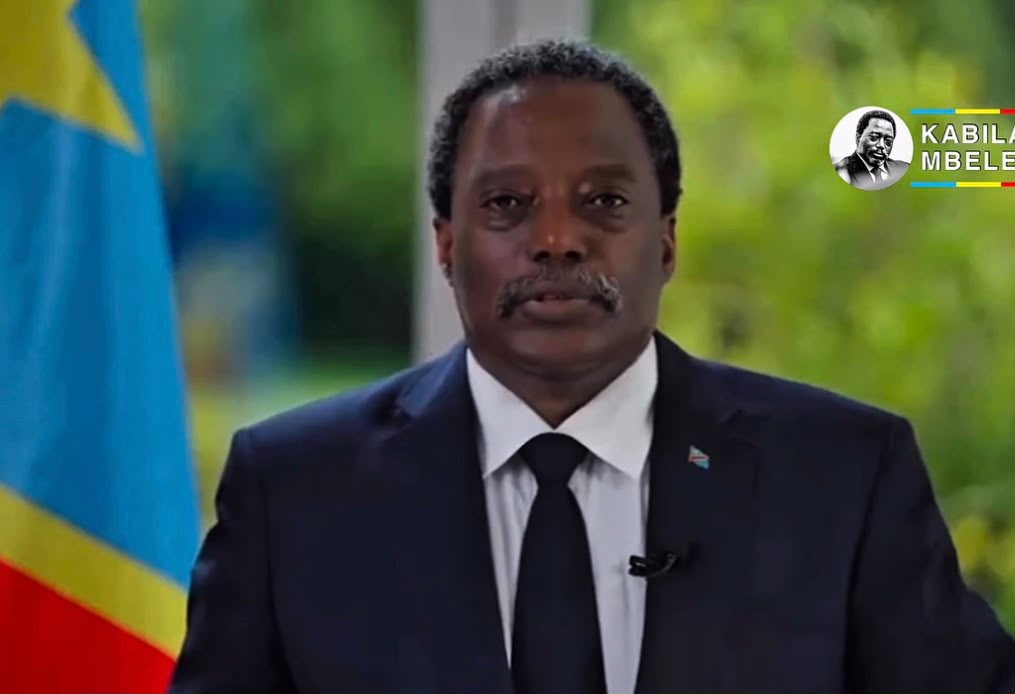
Former Democratic Republic of Congo (DRC) President Joseph Kabila has been named leader of a new political and military coalition opposing President Félix Tshisekedi’s government, in a development that brings prominent figures associated with the M23 rebellion into a new alliance and could complicate efforts to end the conflict in eastern Congo.
The Front for the Refoundation of the Nation (FRN), announced in the eastern city of Goma on Monday, October 12, brings together anti-government forces under Kabila’s leadership. Its founders say they intend to unite opposition groups to bring political change to the country, accusing the government in Kinshasa of authoritarian rule and failing to address the country’s political, economic and security problems.
The coalition’s announcement was delivered by Claude Ibalanky, a former adviser to Tshisekedi, who said the movement intended to coordinate resistance forces and restore what it described as the foundations of a functioning republic.
“The mission of the Front for the Refoundation of the Nation is to unite and coordinate all resistance forces to put an end to tyranny by any means necessary, including the use of force,” Ibalanky said, according to the coalition’s declaration.
The statement makes clear that the new front is not presenting itself solely as a conventional political opposition party. Its founders have explicitly left open the use of force, although the announcement did not set out a specific military timetable or announce a new offensive.
The FRN also marks a reorganisation of the political and military alliance previously known as the Congo River Alliance, or AFC. According to Congolese news outlet Actualité.cd, the coalition’s founding document declares that the AFC’s existence has ended and that the FRN succeeds it. The document does not separately clarify the future status of the M23 movement, which has operated within the broader AFC/M23 alliance.
The new leadership includes Corneille Nangaa, the former head of the AFC, and Bertrand Bisimwa, a senior M23 figure, as vice-presidents. Emmanuel Sultani Makenga, another prominent M23 leader, was named chief of general staff of the coalition’s armed wing, identified as the Congolese Revolutionary Army. Freddy Rukema Kaniki was appointed secretary-general.
Kabila’s appointment comes three days after he delivered a national address criticising Tshisekedi’s administration. In that speech, the former president accused the government of undermining constitutional governance, mismanaging the economy and failing to resolve the security crisis.
He also alleged that political opponents and members of the armed forces had been detained without proper justification. Those allegations reflect Kabila’s claims and have not been independently established by the announcement of the new coalition.
The former president’s move into the leadership of the FRN represents a significant change in his political position. Kabila led the DRC from 2001 until January 2019, when he handed power to Tshisekedi following an election whose outcome was disputed by several political actors. Since leaving office, his relationship with the current administration has deteriorated, and he has become increasingly critical of its handling of the country’s affairs.
The coalition’s formation also brings renewed attention to Kabila’s alleged links to armed groups in eastern Congo. The DRC government and international actors have accused Rwanda of supporting M23, an allegation Rwanda denies. Kabila has also faced accusations of cooperating with the rebels, which he has rejected. His new leadership role places him at the head of a coalition that includes figures from the movement, rather than merely leaving him as a political critic outside the alliance.
Kabila was sentenced to death in absentia by a Congolese military court in 2025 after being convicted on charges including treason, war crimes and crimes against humanity. He has dismissed the proceedings as politically motivated and denied the accusations against him. The case has added to the confrontation between the former president and Tshisekedi’s government.
The announcement comes as diplomatic efforts to resolve the conflict in eastern Congo continue. The African Union has recently engaged with rebel representatives and urged continued peace negotiations, while international mediation efforts have sought to reduce fighting and establish arrangements for a lasting settlement. The emergence of a new coalition under Kabila, with senior AFC/M23 figures in its leadership, introduces another complication for those efforts.
The conflict has displaced large numbers of people and created a major humanitarian crisis in eastern Congo, where M23 has seized extensive territory. Goma, the city where the FRN was announced, has been under M23 control since January 2025. The coalition’s formation there underlines the extent to which political developments and armed-group activity have become intertwined in the east.
The FRN says it wants to rebuild state institutions, strengthen justice and citizenship, redistribute national wealth and facilitate the return of refugees and political exiles. It presents itself as an alternative to the current political system, rather than a movement seeking only a place within it. Its founding declaration, however, does not resolve how its stated political objectives will be pursued or how the inclusion of armed groups will affect its approach to negotiations.
The government had not issued an immediate official response to the coalition’s announcement at the time of reporting. Its position on Kabila’s new leadership and the coalition’s stated willingness to use force therefore remains unconfirmed.
The central question now is whether the FRN will pursue its objectives through negotiations, armed confrontation or a combination of political and military pressure. Its leadership has declared that force remains an option, but the group has not announced a specific military operation. What is clear is that Kabila’s appointment places the former president at the head of a new coalition that directly challenges Tshisekedi’s government while bringing the conflict’s political and armed opposition figures into a reorganised structure.