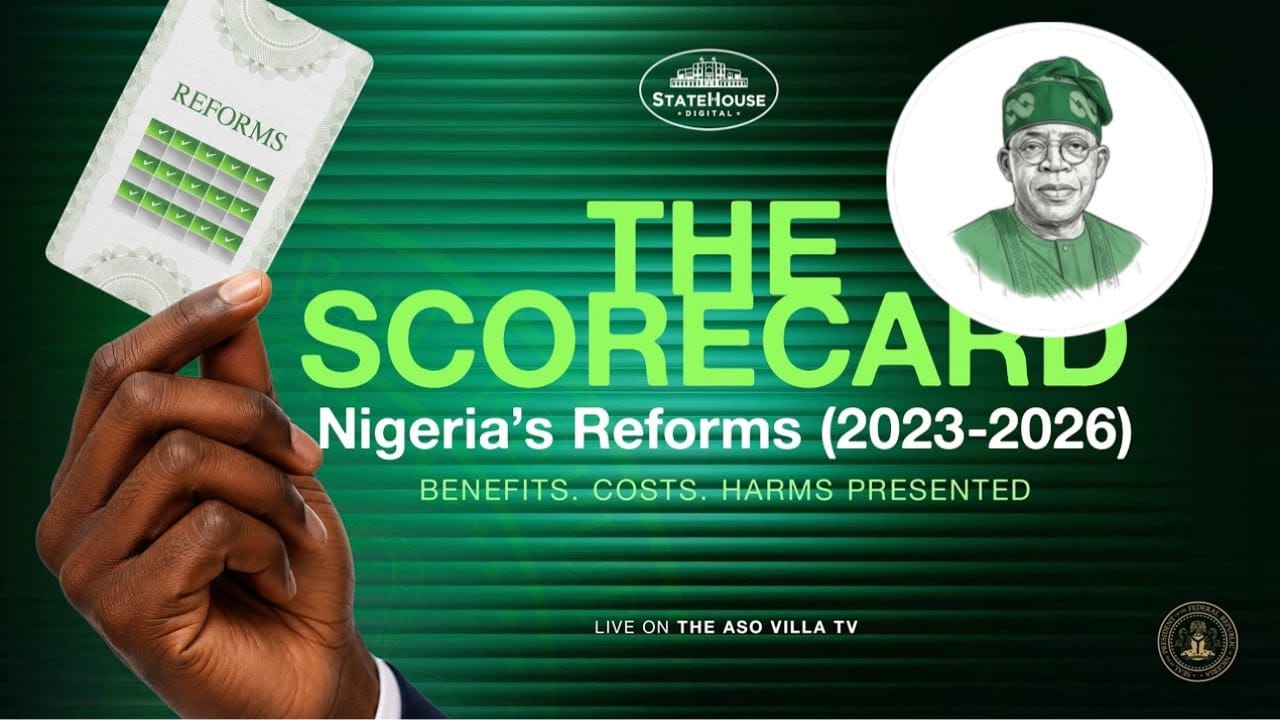
President Bola Tinubu’s government has acknowledged that its economic reforms have imposed high costs on Nigerians while arguing that the measures prevented a deeper fiscal and economic crisis.
The Federal Government assessed on Wednesday, August 19, 2026, as Finance Minister and Coordinating Minister of the Economy Taiwo Oyedele presented Nigeria’s Reform Scorecard, detailing the benefits, costs and potential economic harm the government says it has avoided since Tinubu introduced major reforms in 2023.
The scorecard comes after Tinubu directed Oyedele to provide Nigerians with a detailed account of the reforms, saying citizens deserved to see the numbers and understand how the government’s decisions had affected their families, businesses and the wider economy.
The reforms have included the removal of the petrol subsidy and changes to Nigeria’s foreign-exchange system, two of the most consequential economic decisions taken by the Tinubu administration since it came to power.
According to the government, the removal of the petrol subsidy and foreign-exchange reforms generated ₦15.8 trillion in additional resources for the Federation between June 2023 and December 2025.
Of that amount, the Federal Government received ₦5.4 trillion, while ₦10.4 trillion was distributed among Nigeria’s states and local governments.
Oyedele, however, clarified that the ₦15.8 trillion did not appear as a separate payment labelled “subsidy savings” in the Federation Account.
Instead, the government says the reforms increased the naira value of revenues accruing to the Federation through changes in the exchange rate and the removal of distortions associated with the former subsidy system.
The minister said the government was not presenting the scorecard simply as a declaration of success.
“We invited you here today not to declare a victory, but to give an account,” Oyedele said.
He acknowledged that the reforms had created hardship for households and businesses, arguing that judging them solely by comparing prices before and after the changes would overlook the potential consequences of inaction.
The government argues that some of the most important benefits of the reforms lie in what it believes did not happen, including a deeper fiscal crisis, greater economic distortions, and further pressure on Nigeria’s external finances.
The foreign-exchange reforms, for example, were introduced after the previous system had created large disparities between official and other exchange rates. The government says the old system encouraged arbitrage and corruption and had become increasingly difficult to sustain.
At the same time, the naira’s depreciation has increased the domestic cost of servicing Nigeria’s foreign-currency debt.
Oyedele illustrated the problem by noting that a US$1 million interest payment remained US$1 million, but its naira cost increased substantially after the currency weakened.
The government has also pointed to measures introduced to cushion Nigerians from the impact of the reforms, including an increase in the minimum wage from ₦30,000 to ₦70,000, student loans, cash transfers, subsidised mortgages and agricultural support.
But the government concedes that macroeconomic improvements have not yet fully translated into improved living standards for many Nigerians.
That distinction is particularly important as the administration seeks to demonstrate that economic stabilisation will eventually translate into higher incomes, lower poverty and better household welfare.
The Federal Government has therefore begun placing greater emphasis on measuring indicators such as poverty, real income and inequality to determine whether economic reforms are improving the lives of ordinary Nigerians.
Tinubu announced the scorecard after saying Nigerians had a right to understand both the costs and results of the policies introduced since 2023.
“When we began this journey of reform in 2023, I promised that the difficult decisions we were making would serve the purpose of building an economy that works better for you and a country that is stronger for our children,” Tinubu said.
“You deserve to see the numbers. You deserve to know what has changed and what these reforms mean for you, your family, your business and our country.”